
The new era of hotel communication: conversation, automation and artificial intelligence
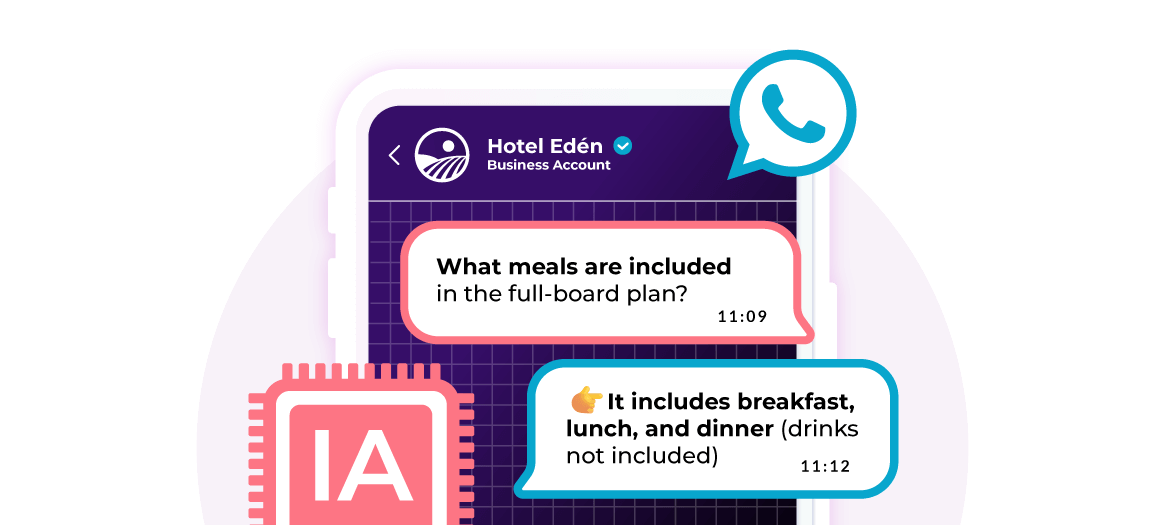
The integration of WhatsApp and artificial intelligence marks a new stage in the guest experience and hotel communication, transforming the digital relationship between hotels and travelers into a more immediate, automated, and data-driven model.

The consolidation of WhatsApp as a universal communication channel and the advancement of generative artificial intelligence are redefining the way hotels interact with their guests. We are not talking about a passing trend, but rather a structural change.
The new role of hotel marketing: conversation and automation
For years, hotel marketing has been focused on campaigns. Seasonal campaigns, loyalty campaigns, reactivation campaigns, upselling campaigns. The focus was on immediate impact: sending a message at the right time to trigger a specific conversion.
Email marketing has undoubtedly been the star of this era. It has allowed hotels to regain some control over their databases, reduce their dependence on intermediaries and generate direct bookings with a relatively efficient investment. But email, by definition, is an asynchronous and one-way channel: the hotel sends, the guest receives. Interaction exists, but it is neither immediate nor conversational.
Today, the context has changed. Guests operate in instant messaging environments where communication is fluid, bidirectional and practically in real time. Conversation is no longer the exception: it is the norm.
For hotel chain marketing managers, this represents a profound transformation. The strategy is no longer based solely on scheduled mailings but is structured around dynamic flows that are activated based on guest behaviour. We are not simply talking about classic automation—such as a pre-stay sequence or a post-check-out email—but interactions that adapt to what the guest asks, needs or does at any given moment.
The real disruption is not in the channel, but in the architecture that supports it. When messaging is connected to the CRM, PMS and the rest of the hotel’s technological ecosystem, communication ceases to be generic and becomes contextual. The message is no longer the same for everyone, not even for all guests in the same segment. It is a conversation that evolves according to the profile, the history of stays, the contracted regime, the time of travel or even the language detected.
In this model, the experience is no longer linear. It is not a chain of pre-designed impacts that the guest passively goes through. It is a continuous dialogue in which each response modifies the next step.
For example, if the guest asks about the spa, the conversation can lead to a personalised recommendation. If they ask about breakfast times, it can open the door to additional suggestions. Automation is no longer rigid, it is adaptive.
This change also redefines brand perception. Immediacy has become an implicit standard. When a guest writes and receives an instant response, they perceive efficiency, modernity and closeness. When they write and have to wait hours—or do not get a clear answer—the feeling is the opposite. It is not just about resolving queries; it is about how the digital relationship with the hotel feels.
In this sense, marketing is no longer solely a function of customer acquisition and loyalty, but has become a key part of the guest experience. Conversation no longer belongs exclusively to the reception department or the sales team: it is cross-functional. It impacts satisfaction, online reputation, ancillary revenue and future loyalty.
The change in guest behaviour: immediacy and conversation
Traveller behaviour has changed:
- They check their mobile phones dozens of times a day.
- They expect immediate responses.
- They prefer short messages to calls or forms.
- They value self-sufficiency.
- They are increasingly less tolerant of friction.
This change is not unique to tourism. It is in line with the global evolution of digital consumption: conversational commerce, automated customer service, virtual assistants, advanced chatbots and AI models that interact in natural language.
Guests no longer want to “contact the hotel”. They want to write a message and get a solution in seconds. And if they don’t get it, they will look for another option.
WhatsApp Business in hospitality: from informal channel to operational standard
Five years ago, many hotels used WhatsApp as an alternative number managed manually by reception. Today, the market is much more sophisticated.
The maturity of the channel has evolved into three levels:
1. Professionalisation of the channel
WhatsApp Business API allows you to:
- Automate messages.
- Integrate systems (PMS, CRM, booking engine).
- Scaling conversations.
- Maintain brand consistency.
It is no longer an informal channel. It is a business tool with advanced capabilities.
2. Integration with hotel processes
The real value is not in “having WhatsApp”, but in integrating it with:
- Online check-in.
- Operational requests.
- Upselling during the stay.
- Satisfaction surveys.
- Post-stay loyalty.
When the channel is connected to the hotel’s technological ecosystem, it becomes a cross-cutting axis of the experience.
3. Intelligent conversation with AI
The incorporation of Artificial Intelligence radically changes the model.
An AI concierge can:
- Answer frequently asked questions 24/7.
- Recommend personalised services.
- Understand natural language in multiple languages.
- Manage multiple conversations simultaneously.
- Learn from interactions.
This does not replace the human team. It frees them from repetitive tasks and allows them to focus on situations that really require judgement and empathy.
What it means for hotel chains to have these tools at their disposal
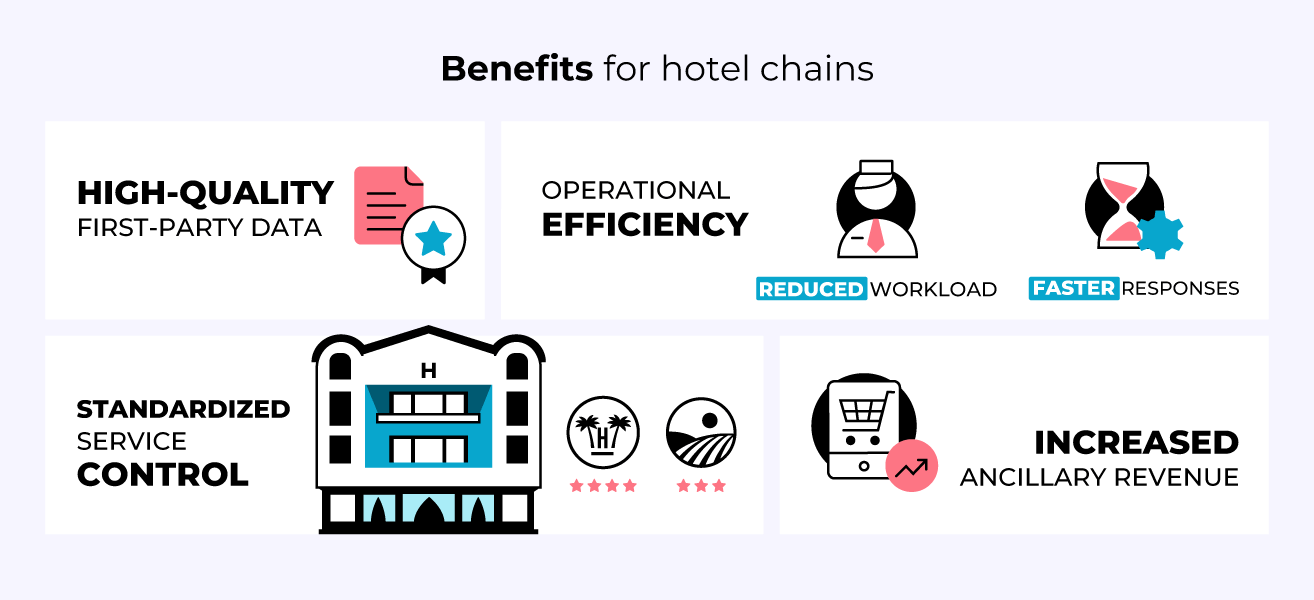
For a chain manager, WhatsApp + AI is not just an operational improvement. It is a strategic decision that impacts four major areas:
1. Efficiency and reduced pressure on reception
The most frequent requests (schedules, amenities, transport, basic incidents) can be handled automatically.
This represents a substantial improvement in customer service:
- It reduces waiting times.
- It improves the perception of agility.
- It reduces the operational workload of employees.
- It optimises costs without affecting quality.
2. Standardisation of the experience across multiple properties
One of the major challenges for chains is maintaining consistency in communication between their different hotels.
A centralised conversational system allows you to:
- Establish a uniform tone.
- Ensure responses are aligned with the brand.
- Avoid improvisation.
- Control service standards.
3. Generating quality data
Every interaction generates valuable information:
- Guest interests.
- Purchase intent.
- Peak demand times.
- Frictions in the experience.
In a context where information related to guest usage is increasingly relevant (especially given the gradual disappearance of third-party cookies), the conversational channel becomes a direct source of proprietary data.
4. Direct impact on complementary revenue
Conversation allows services to be offered at the right time, achieving a better conversion rate for upgrades, internal or external experiences, restaurants, etc.
The key difference is the context. It is not a mass campaign. It is a personalised recommendation at the right moment.
Where does the hotel sector stand in relation to these new tools?
The hotel sector is in an intermediate phase of adopting these advanced conversational models. We are not in an experimental stage, but neither are we in a phase of full maturity. Some chains, especially those with a more digital culture, have already integrated automated conversation as a central part of their strategy. Others continue to operate with traditional schemes where messaging is an informal complement rather than a structured channel.
This intermediate point creates a clear strategic opportunity. When a technology is not yet fully standardised, those who integrate it with a long-term vision can gain a significant competitive advantage. Not so much for the simple fact of “being there”, but for how it is used.
There is a substantial difference between opening a WhatsApp channel and redesigning the digital relationship with the guest. The former is a technical implementation. The latter is a strategic decision that involves reviewing processes, communication tone, systems integration and commercial objectives.
The competitive advantage in this phase does not lie in the tool itself, but in the consistency of the model. Chains that understand that conversation is part of the hotel product — just like the room or breakfast — are building a more fluid experience that is aligned with the current expectations of travellers.
Because, ultimately, it is not about installing yet another channel. It is about accepting that the relationship between hotel and guest is no longer episodic, but continuous. And whoever designs that continuity best will lead the next stage of the hotel experience.
How can WhatsApp and an AI concierge be integrated into the guest experience strategy?
If you want to understand how to structure this type of solution within your technological ecosystem and what impact it can have on operational efficiency, loyalty and direct sales, you can schedule a demo.