

Hotel online check-in: how to implement it step by step without affecting front desk operations
Online check-in allows hotels to streamline guest arrivals, reduce front desk queues and optimise operational processes. In this guide, we explain what hotels need to implement it correctly, how the process works and what mistakes to avoid when integrating it without affecting daily operations.

Digitalisation in the hotel industry is no longer a future trend, but an operational necessity. One of the most visible changes in recent years has been the adoption of hotel online check-in, a solution that allows guests to complete their registration before arriving at the hotel.
For hotels, this type of tool not only improves the guest experience, but also helps reduce the workload at the front desk, minimise queues and optimise operational processes.
However, implementing an online check-in system is not simply a matter of adding a form to the website or giving guests a tablet upon arrival. For it to work properly, it needs to be integrated into the hotel’s operations and technological systems.
In this guide, we explain how to implement it step by step without affecting front desk operations.
Why more and more hotels are digitising check-in
Reception has traditionally been one of the most important points in the guest experience. However, it is also one of the processes that generates the most friction upon arrival.
Among the most common problems are:
- Queues at reception during peak occupancy times.
- Manual registration processes.
- Repetitive data entry by staff.
- Unnecessary waiting times for guests, which in many cases will be their first impression of the establishment.
Online check-in solves many of these problems by moving part of the process to before arrival.
This way, guests can fill in their details on their mobile phone or in the booking confirmation email, allowing the hotel to speed up the arrival process and devote more time to personalised service.
In addition, digitising check-in also allows for:
- Automate the collection of guest data.
- Comply with passenger registration regulations.
- Reduce human error in data entry.
- Integrate the process with other hotel systems.
What a hotel needs to implement online check-in
Before implementing a digital check-in system, it is important for the hotel to have certain basic elements in place to ensure that the process works correctly.
The main ones are:
Integration with the PMS
The online check-in system must be connected to the hotel’s PMS so that the data entered by the guest is automatically recorded in the reservation.
This avoids duplication of tasks at reception and reduces errors in data management.
Automated communication with the guest
The guest must receive the check-in link before their arrival. This is usually done by:
- A booking confirmation email.
- Pre-arrival reminder.
- Link from the hotel’s website or app.
The key is for the process to be quick and accessible from a mobile device.
Mobile-optimised form
Most guests will complete check-in from their smartphone. Therefore, the form must be:
- Simple.
- Quick to complete.
- Adapted to mobile screens.
- With as few steps as possible.
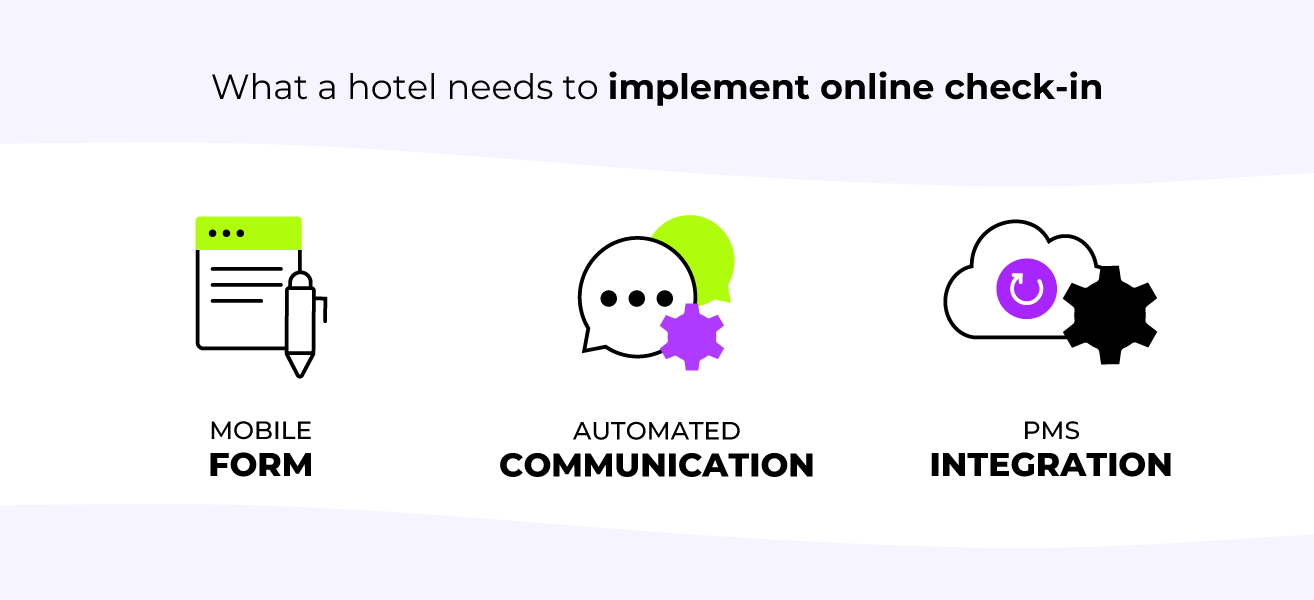
The simpler the system, the higher the completion rate. However, we must not forget that there is a series of mandatory details that guests must fill in, so the information must be clear and users must know at all times what stage of the process they are at.
How the online check-in process works in hotels
The online check-in process usually follows a fairly simple flow that begins before the guest’s arrival.
1. Booking confirmation
Once the booking has been made, the hotel sends a confirmation email that includes the details of the stay. If the booking was made through an OTA, a link to the online check-in can be included in the confirmation email.
2. Sending the online check-in link
A few days before arrival, the guest receives a link that allows them to complete the check-in process.
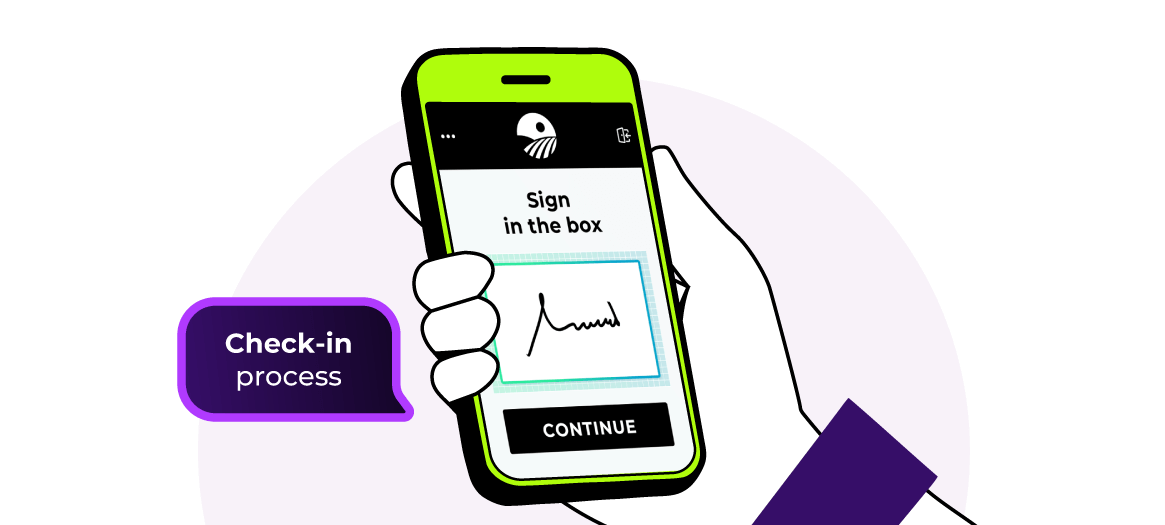
3. Entering personal details
The guest enters the information required for registration, such as:
- First and last names.
- Identity document.
- Contact details.
- Companions on the booking.
In many systems, it is also possible to scan the identity document automatically.
4. Confirmation of registration
Once the process is complete, the data is automatically recorded in the hotel system.
When guests arrive at the establishment, the reception process is considerably reduced, as most of the registration has already been completed. It is simply a matter of confirming the information and handing over the key.
Mandatory data and guest registration regulations
This is possibly one of the most sensitive issues and one that can cause the most friction, but if done properly, it can be a process that benefits both parties.
In many countries, hotels are required to register guest details and send them to the relevant authorities.
Online check-in can greatly facilitate this process, as it allows the necessary information to be collected digitally.
The most common data to be collected includes:
- Full name.
- Identity card or passport number.
- Nationality.
- Date of birth.
- Date of entry.
Digitising the process helps to avoid manual errors and ensure that all data is recorded correctly.
In addition, some systems allow you to automatically generate the passenger reports required by regulations.
Common errors when implementing digital check-in
Although digital check-in offers many advantages, its implementation can cause problems if it is not designed correctly.
Here are some of the most common errors.
Forms that are too long
One of the main reasons guests abandon the process is that the form is too long or complex.
It is advisable to ask only for essential information.
Processes not adapted to mobile devices
If the process is not optimised for smartphones, many guests will not complete the check-in.
The design must be mobile first.
Lack of integration with hotel systems
If the check-in system is not connected to the PMS, reception staff will have to re-enter the data manually.
This eliminates much of the operational benefit.
Lack of communication with the guest
Many hotels implement online check-in but do not inform guests properly.
It is important to include the link in booking emails and pre-arrival reminders.
Integrations that a good online check-in should have
For online check-in to truly improve operations, it is essential that it is connected to the hotel’s technological ecosystem.
Among the most important integrations are:
- PMS to automatically record guest data.
- Hotel CRM to enrich the customer profile.
- Communication systems to send reminders and confirmations.
- Operational automation systems.
When digital check-in is properly integrated, the hotel can automate much of the guest arrival process.
Results hotels are seeing with digital check-in
Hotels that successfully implement online check-in often see improvements in various aspects of their operations.
Among the most common benefits are:
- Reduced queues at reception.
- Less administrative burden on staff.
- Faster arrival processes.
- Improved guest experience.
- Greater accuracy in data collection.
- Improved online reputation rankings.
In addition, by automating part of the process, reception staff can devote more time to higher-value tasks, such as personalised service or the sale of additional services.
Frequently asked questions from our customers about implementing online check-in in hotels
How does online check-in integrate with the hotel’s PMS?
Integration with the PMS is one of the key elements for online check-in to function correctly within the hotel’s operations. In most current solutions, this connection is made through API integrations with the PMS, which allows information to be synchronised automatically and in real time.
When the guest completes the online check-in, the data entered — such as personal information, identity document or accompanying persons on the booking — is sent directly to the hotel’s PMS and associated with the corresponding booking.
Thanks to this integration, the system can:
- Automatically retrieve the existing booking data.
- Validate the information entered by the guest.
- Update the customer’s profile in the PMS.
- Avoid manual data entry at reception.
This type of integration allows digital check-in to be integrated into the hotel’s operational flow without creating additional work for staff, as the information is automatically recorded in the establishment’s management system.
In addition, the most advanced solutions usually offer compatibility with the main PMS on the market, which facilitates the implementation of online check-in without the need for customised developments.
What percentage of guests usually complete online check-in before arrival?
The adoption of online check-in still varies considerably depending on the type of hotel, the market and the digital experience offered by the establishment. However, industry data shows a clear trend towards growth.
For example, an analysis based on more than 4,000 hotels using the Mews PMS in 85 countries indicates that approximately 20-25% of guests already complete online check-in before arriving at the hotel.
In hotels that have specifically optimised this process—for example, through guest portals or self-service kiosks—the percentages can be significantly higher. In some cases, up to 30% of bookings are processed through self check-in, especially in markets with greater technology adoption such as the United States.
In addition, various studies of traveller behaviour indicate that between 40% and 70% of travellers prefer to check in digitally when given the option, suggesting that adoption will continue to increase as more hotels simplify the process.
In practice, hotels that effectively communicate online check-in prior to arrival and offer a mobile-optimised process typically achieve usage rates in excess of 30-40%, particularly in city hotels, chains, or establishments with a significant base of repeat travellers.
How does online check-in affect front desk operations?
When online check-in is well integrated with the PMS and hotel systems, it can significantly reduce the operational burden on reception. Much of the administrative work—such as entering guest data, scanning documents, or verifying information—is completed before arrival.
This has a direct impact on arrival times. Industry studies indicate that traditional check-in processes can easily exceed 5 minutes, while digital or mobile check-in systems can reduce the process to less than 90 seconds, significantly speeding up guest arrival.
In the case of kiosks or self-check-in systems, the entire process can be completed in around 1-2 minutes, which is up to 70-75% less time than a traditional check-in at reception.
In addition to saving time, automation allows for the redistribution of staff work. By transferring repetitive tasks to digital systems, reception teams can focus on higher-value functions, such as:
- Personalised guest service.
- Incident management.
- Upselling services or upgrades.
- Coordination with other hotel departments.
From an operational standpoint, this allows many hotels to manage peak arrivals with less pressure on reception, improve the guest experience, and optimise team productivity without increasing staff.
In practice, online check-in does not eliminate the reception desk, but rather transforms it: it reduces administrative work and allows staff to focus on the guest experience.