From traditional CRM to omnichannel AI CRM: why hotels need to connect conversations, bookings and management
Hotel CRM has stopped being a simple database and has become an AI-powered omnichannel environment. Integrated with PMS, booking engine, WhatsApp, chatbot, email marketing and call centre, it allows hotels to offer a more natural, personalised and connected experience throughout the entire guest journey.
 Manel LópezHead of Sales & Business Development
Want to see more of Hotelinking’s content on Google?
For years, many hotels have understood CRM as a tool for storing customer data, sending email marketing campaigns or segmenting past guests. And although all of that remains important, today it is no longer enough.
Today’s guest does not interact with a hotel through a single channel. They may discover the property on Google, ask a question on WhatsApp, compare prices on an OTA or on ChatGPT, call to clear up a doubt, book on the website, receive an email before arrival and write again via chat during their stay.
The question is no longer whether the hotel has these communication channels available to the guest. The real question is: are all those channels connected to each other and able to maintain a coherent conversation with the guest?
This is where CRM has taken an important leap forward. We are no longer talking only about integrating tools, but about building a more intelligent relationship environment, powered by AI, where every interaction can be understood in context: who the guest is, what they have asked about, whether they have an active booking, what stage of the journey they are in and what they need at that moment.
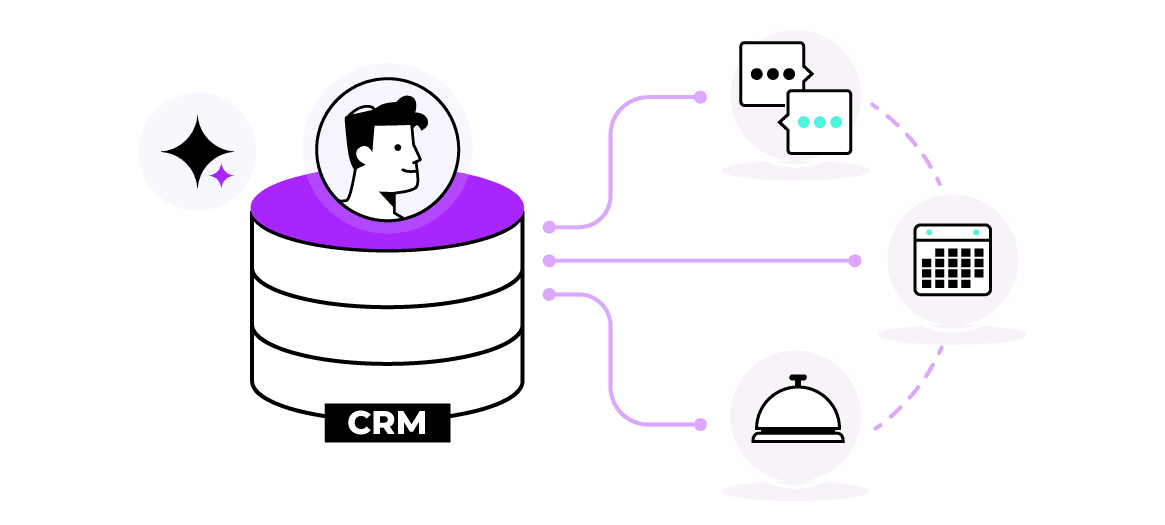
The new omnichannel CRM for hotels is no longer simply a commercial database. It becomes the connection point between marketing, sales, reservations, guest service and hotel management.
CRM can no longer live in isolation
A CRM that does not communicate with the PMS, the booking engine or the service channels ends up creating more work than it solves.
Let us imagine a common situation.
A guest asks on WhatsApp whether they can book a room with an extra bed. Then they call to ask whether parking is available. Later, they enter the website, abandon the booking process and, the next day, receive a generic email campaign that has nothing to do with what they were looking for.
The problem is not the lack of channels. The problem is that each channel is operating independently.
In a hotel, real omnichannel communication is not about “being on WhatsApp, email, phone and chat”. It is about making sure all those touchpoints share context, data and traceability.
And thanks to today’s artificial intelligence tools, that connection can be much more natural. Not only for the hotel team, which works with a more organised view, but also for the guest, who feels they are continuing the same conversation even when they change channel.
AI has changed the way we understand omnichannel communication
For a long time, omnichannel communication was explained as the ability to be present across several channels: email, phone, chat, WhatsApp, web forms or social media.
But being present is no longer enough.
A hotel can have all those channels open and still offer a fragmented experience if each conversation is managed separately.
The difference today is that AI-based tools make it possible to interpret, organise and activate information in a much more natural way. It is not only about the CRM receiving data from the PMS or the booking engine. It is about using that data to understand each conversation better.
For example, AI can help to:
- Identify the intent of an enquiry: booking, modification, cancellation, upselling, incident or general information.
- Summarise previous conversations so the team does not have to read the full history.
- Suggest responses that are consistent with the hotel’s tone of voice.
- Detect commercial opportunities in chats, calls or WhatsApp messages.
- Trigger automations based on the stage of the guest journey.
- Route to the human team the conversations that truly require personalised attention.
- Maintain context even when the guest changes channel.
This represents an important shift: the user no longer feels that they are starting from scratch every time they contact the hotel.
An example we have all experienced outside the hotel industry is those long calls to our phone provider where we have to explain the same problem again each time we are transferred to a different person.
AI enables the hotel team to stop working with disconnected pieces and instead operate within the same environment, with more context and less friction.
What makes an omnichannel hotel CRM different?
An omnichannel CRM designed for hotels must go far beyond registering contacts. It should help the team understand who the guest is, what they need, what stage of the journey they are in and what commercial or service opportunity exists in each interaction.
| Before: traditional CRM | Now: omnichannel hotel CRM with AI |
|---|---|
| Customer database | Complete and contextual guest history |
| Isolated email campaigns | Coordinated communication by email, WhatsApp, chatbot, phone and other channels |
| General segmentation | Segmentation based on booking, behaviour, preferences and stage of the journey |
| Commercial management separated from reception | Shared view across reservations, reception, marketing and sales |
| Manual or incomplete data | Integration with PMS, booking engine and digital channels |
| Reactive communication | Intelligent automation before, during and after the stay |
| Scattered conversations | A single environment with traceability and continuity |
| Repetitive responses | AI support to classify, summarise and suggest responses |
The difference is significant: CRM stops being a marketing tool and becomes a relationship, conversion and guest experience tool.
The key lies in integration with the PMS and booking engine
For a CRM to deliver real value to a hotel, it needs to be connected to the systems where the core business activity takes place.
The PMS contains critical information: bookings, stay dates, room type, guest history, preferences, incidents, consumption or booking status.
The booking engine shows commercial intent: searches, availability checked, started bookings, abandoned bookings, promotional codes, selected packages or user source.
When the CRM integrates with both, the hotel can move from generic communication to contextual communication.
For example:
- Send an automatic WhatsApp message to someone who has started a booking but has not completed it.
- Launch an upselling campaign before arrival based on the room type booked.
- Activate a post-stay email requesting a review only from guests who have already checked out.
- Prioritise call centre enquiries from guests with an upcoming arrival.
- Allow a chatbot to answer questions using real information about availability, services or conditions.
- Create segments of repeat guests, corporate clients, families, couples or high-value guests.
- Detect commercial opportunities from real conversations.
- Avoid making the guest repeat information they have already shared in another channel.
Without integration, the team works on intuition. With integration, it works with data. And with AI, that data can become much more natural, fast and useful actions.
From the “connected channel” to the “single environment”
Traditional integration connected systems. The new integration, supported by AI, connects experiences.
This is especially important in hospitality, where the guest may interact with the property at very different moments: before booking, during comparison, after confirming the stay, on arrival, during the visit or after check-out.
| Guest moment | What they need | How an omnichannel CRM with AI helps |
|---|---|---|
| Before booking | Quick answers to questions | Chatbot, WhatsApp or call centre with commercial context |
| During the booking | Trust and ease | Abandonment follow-up, assistance and personalised messages |
| Before arrival | Useful information | Email automation, WhatsApp and upselling actions |
| During the stay | Agile response | Centralised conversations and routing to the right team |
| After check-out | Continuity in the relationship | Surveys, loyalty actions and segmented campaigns |
| For future bookings | Recognition and personalisation | Connected history and proposals adapted to the guest profile |
The key is not simply to have many touchpoints. It is to make sure they all work as part of the same conversation.
When the CRM is integrated with the PMS, booking engine, WhatsApp, email marketing, chatbot and call centre, AI can help organise that information and turn it into useful actions.
The guest does not think in channels: they think in answers
One of the major mistakes in hotel management is organising communication from the hotel’s internal perspective: “reservations handles this”, “reception answers that”, “this depends on marketing”, “this comes through the switchboard”.
The guest does not see it that way.
For them, everything is the hotel.
If they write on WhatsApp and then call, they expect the hotel to know who they are. If they have already booked, they expect not to be treated as a new contact. If they have requested a double bed, they expect that information not to be lost. If they have had an incident during the stay, they expect the next commercial message not to completely ignore that experience.
Omnichannel communication is precisely about avoiding those breaks.
And AI helps make that continuity easier to manage, because it can interpret messages, organise conversations, detect important topics and give the team a clearer view of each case.
The guest does not want to repeat their story
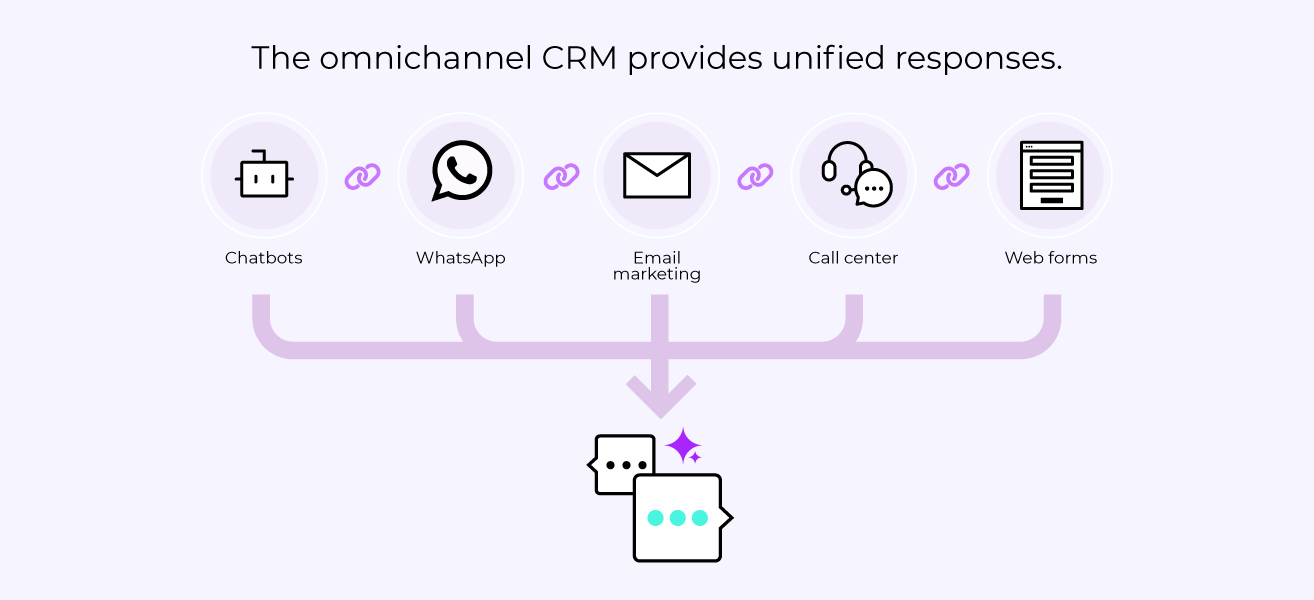
One of the great benefits of an omnichannel CRM with AI is that it helps reduce one of the most common friction points in the relationship with the guest: having to repeat the same information several times.
- “I already called yesterday.”
- “I already sent that information by email.”
- “I already explained this on WhatsApp.”
- “I already have a booking.”
These phrases are signs that the channels are not truly connected.
When information flows within the same environment, the hotel can respond with continuity. The team knows whether the guest has already booked, what room they have, what they requested in a previous conversation or whether there is an open commercial opportunity.
And that continuity creates a very valuable feeling: the guest perceives that the hotel recognises them.
Not necessarily because everything is automatic, but because everything is better connected.
Channels that a hotel CRM should be able to integrate
A useful omnichannel CRM for hotels must be able to connect the channels that truly influence the relationship with the guest and direct sales.
| Channel | Main hotel use | Value for the hotel |
|---|---|---|
| Email marketing | Campaigns, pre-stay, post-stay, loyalty | Segmentation, repeat business and direct sales |
| Quick enquiries, confirmations, commercial follow-up | Immediacy and greater closeness | |
| Web chatbot | 24/7 service, FAQs, lead capture | Less operational workload and more conversion |
| Call centre | Telephone bookings, complex queries, high-value customers | Traceability and commercial follow-up |
| Live chat | Support during website browsing | Reduced abandonment in the booking engine |
| Web forms | Requests for groups, events, weddings or companies | Structured opportunity capture |
| PMS | Stay data, history and guest profile | Real personalisation |
| Booking engine | Purchase intent and direct bookings | Opportunity recovery |
| Conversational AI | Classification, summaries, suggestions and automation | More agility and continuity across channels |
The goal is not to add tools for the sake of adding tools. The goal is for each channel to feed a single view of the guest.
Automation does not mean dehumanisation
In hospitality, poorly applied technology can create distance. But when applied well, it achieves exactly the opposite: it makes the relationship more fluid, faster and more personalised.
AI makes it possible to automate repetitive tasks without making the guest feel they are speaking to a rigid system. A chatbot can answer frequently asked questions, but it can also recognise when a query needs to be passed to a person. An assistant can help the reservations team prepare a response, but the final judgement remains human. An automation can send a pre-stay message, but with information that is relevant to the guest’s actual booking.
The difference lies in balance.
| Can be supported by AI | Should keep human judgement |
|---|---|
| Frequently asked questions | Sensitive complaints |
| Booking confirmations | Negotiations with groups or companies |
| Arrival reminders | VIP guests or strategic repeat guests |
| Enquiry classification | Incidents with emotional impact |
| Conversation summaries | Complex commercial decisions |
| Response suggestions | Cases that affect reputation |
| Recovery of abandoned bookings | High-value commercial conversations |
| Post-stay surveys | Management of negative or sensitive reviews |
AI does not replace hospitality. It helps scale it without losing naturalness.
Omnichannel CRM, AI and direct sales
Direct sales do not depend only on having a good website or a competitive booking engine. They also depend on the hotel’s ability to accompany the user during the decision-making process.
Many bookings are not lost because of price. They are lost because of lack of response, unresolved doubts, late messages or because the user does not find a clear reason to book directly.
Here, AI can play a very relevant role.
It can detect conversations with booking intent, prioritise opportunities, suggest responses to the commercial team, activate automatic follow-ups or identify users who have shown interest but have not completed the booking.
For example:
- A user asks on WhatsApp about availability for a specific date.
- The CRM records the conversation and links it to a potential opportunity.
- The system can suggest a response, activate a follow-up or route the enquiry to the commercial team.
- If the user later enters the booking engine and abandons it, the hotel can recover that opportunity with a contextual message.
- If they finally book, the information remains connected to the guest profile.
This turns CRM into more than a service tool. It becomes direct support for conversion and loyalty.
Guest information is worth more when it is activated
Hotels already have a lot of data. The problem is that, in too many cases, that data is scattered or not used at the right time.
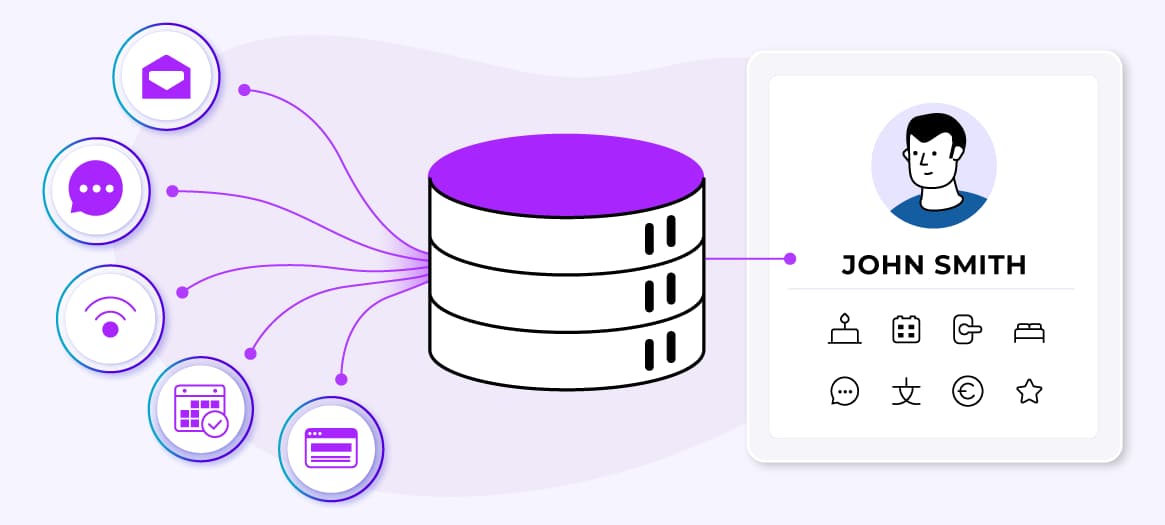
A PMS may know that a guest has stayed three times. The booking engine may know that they are searching for a new stay. The call centre may know that they asked about a superior room. The reception team may remember that they prefer a high floor.
But if that information is not connected, it does not generate value.
An omnichannel CRM allows that data to be activated to improve communication:
- “Thank you for choosing us again.”
- “We have a room available similar to the one from your last stay.”
- “We remind you that you can add parking to your booking.”
- “As a repeat guest, you can access this benefit when booking directly.”
- “We saw that you were checking availability for these dates. Can we help you?”
- “We have seen that your arrival is tomorrow. Do you need help with the transfer?”
- “During your last stay you enjoyed our spa. Would you like to add it to your booking again?”
Personalisation is not about putting the guest’s name in an email. It is about showing that the hotel understands their context.
If this topic interests you, we’ve prepared a practical guide on AI applied to hotels that expands on many of the ideas covered in this article: how to start with specific use cases, which mistakes to avoid, why the hotel’s knowledge base is key, and how to move forward without losing operational control or the human touch.
You can download it here: Practical Guide to AI Applied to Hotels.
What a hotel should review before implementing an omnichannel CRM
Before choosing a tool, it is worth asking a few practical questions:
- What channels do we currently use to communicate with guests and potential customers?
- Where is most information lost: email, phone, WhatsApp, reception or forms?
- Can the CRM integrate with our PMS?
- Can it connect to the booking engine?
- Does it allow messages to be automated based on stay dates or booking status?
- Can it manage WhatsApp, chatbot, email marketing and calls using a common logic?
- Can the commercial team see the full history of each contact?
- Can we measure response times, open opportunities and recovered bookings?
- Does the tool help us sell more, or does it only store data?
- Does AI help classify, summarise and prioritise conversations?
- Can the guest change channel without losing context?
- Do we have support to configure it according to our real processes?
Technology matters, but process design matters even more.
The real change: from handling channels to managing relationships
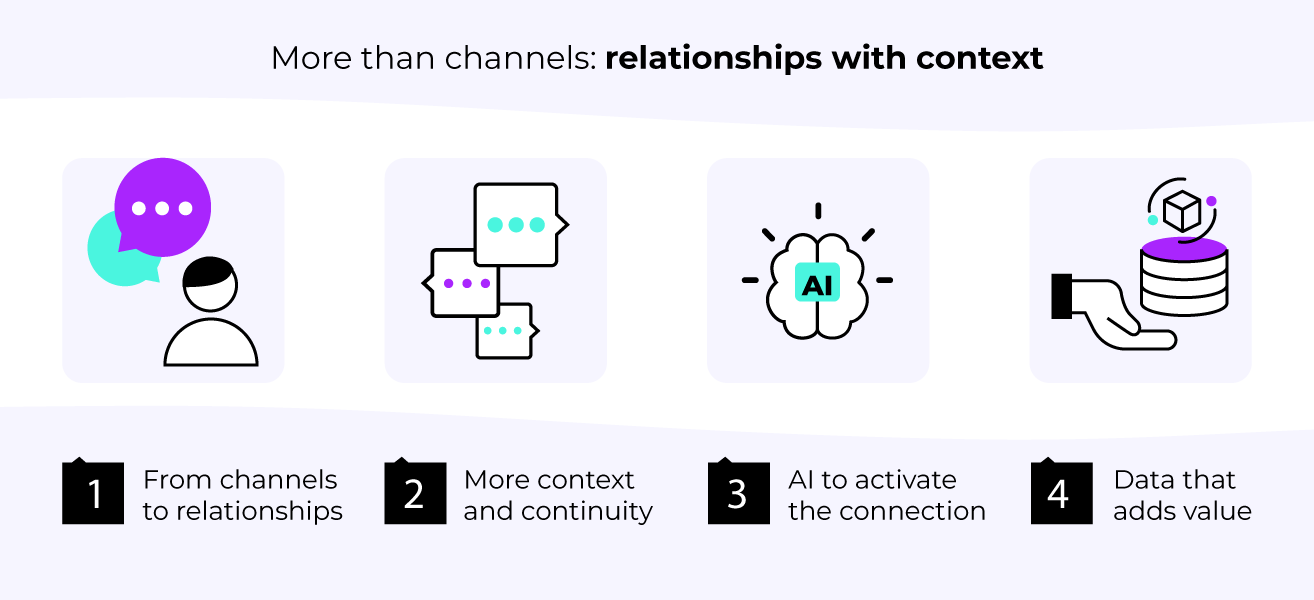
Omnichannel CRM represents a change of mindset for the hotel industry.
It is not only about answering more messages or being present in more channels. It is about managing each relationship better, with more context, more intelligence and less friction.
AI has accelerated this evolution because it makes integrations more natural, activates information at the right time and enables both the guest and the hotel team to work within a more continuous experience.
A hotel that connects its CRM with the PMS, booking engine, WhatsApp, email marketing, chatbot and call centre does not only gain efficiency. It gains the ability to better understand the guest, anticipate their needs and turn every interaction into an opportunity for service, direct sales or loyalty.
Because the future of hotel CRM is not about accumulating contacts.
It is about creating an intelligent environment where every conversation has context, continuity and value.