From monitoring to operations: why a green dashboard is no longer enough to operate a hotel network
Operating a hotel network is no longer just about checking whether devices are green. Today’s complexity requires real visibility, history, context and the ability to anticipate issues in order to distinguish a one-off incident from a structural problem. WiFiBot makes it possible to move from basic monitoring to data-driven network operations, with traceability and better-informed technical decisions.

For years, many hotel networks have been managed according to an apparently simple logic: if devices are green, everything is working. If an alert appears, it is checked. If a guest calls, it is investigated. And if the problem happens again, the cause is sought by cross-checking information across dashboards, terminals, spreadsheets, tickets and internal calls.
The problem is that this way of operating no longer fits the reality of modern hotel infrastructure.
Today, a network does not just connect rooms. It supports guest and employee WiFi access, internal services, IP telephony, management systems, cameras, points of sale, IoT devices, internet links, segmented networks, captive portals and, in many cases, infrastructures distributed across different hotels, buildings or sites.
In that context, knowing that a device is “active” does not mean knowing whether the network is performing properly.
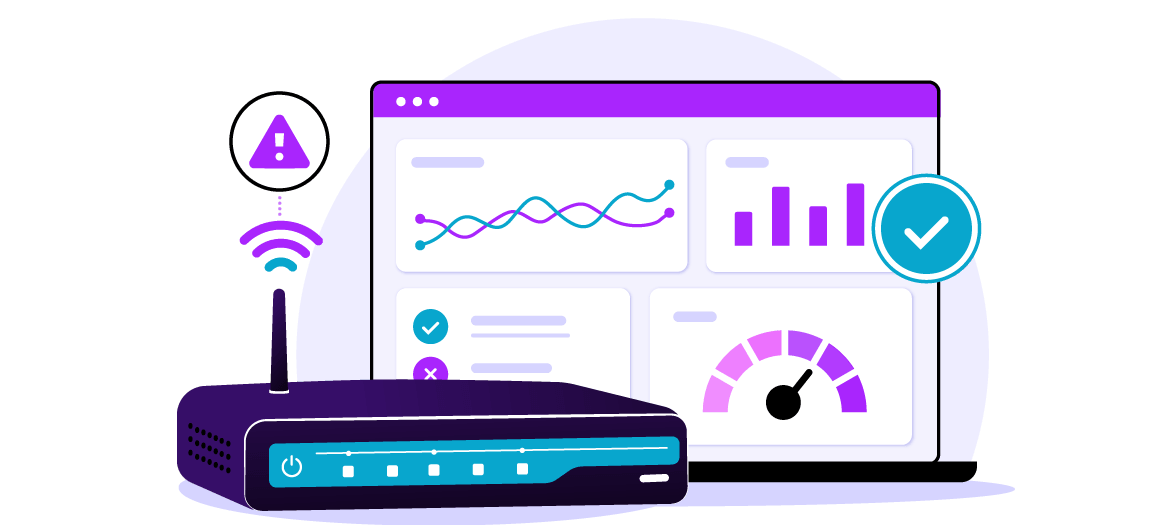
A green dashboard can hide progressive degradation in the optical signal, occasional saturation at certain access points, a drop in performance during specific time slots, a configuration that has drifted away from the standard, or an incident that has not yet reached the end user but is already visible in the data.
That is why network operations need to go beyond basic monitoring.
The status of a single device does not tell the whole story
Traditional monitoring usually answers a limited question: is the device powered on and responding?
That information is necessary, but not enough.
An access point may be online and still deliver a poor experience because it is overloaded. An ONT may continue to work while showing optical degradation that will eventually cause an incident. A link may be up but have enough latency, jitter or packet loss to affect certain services. A network may look stable in a general view and, at the same time, be accumulating small symptoms that anticipate a larger problem.
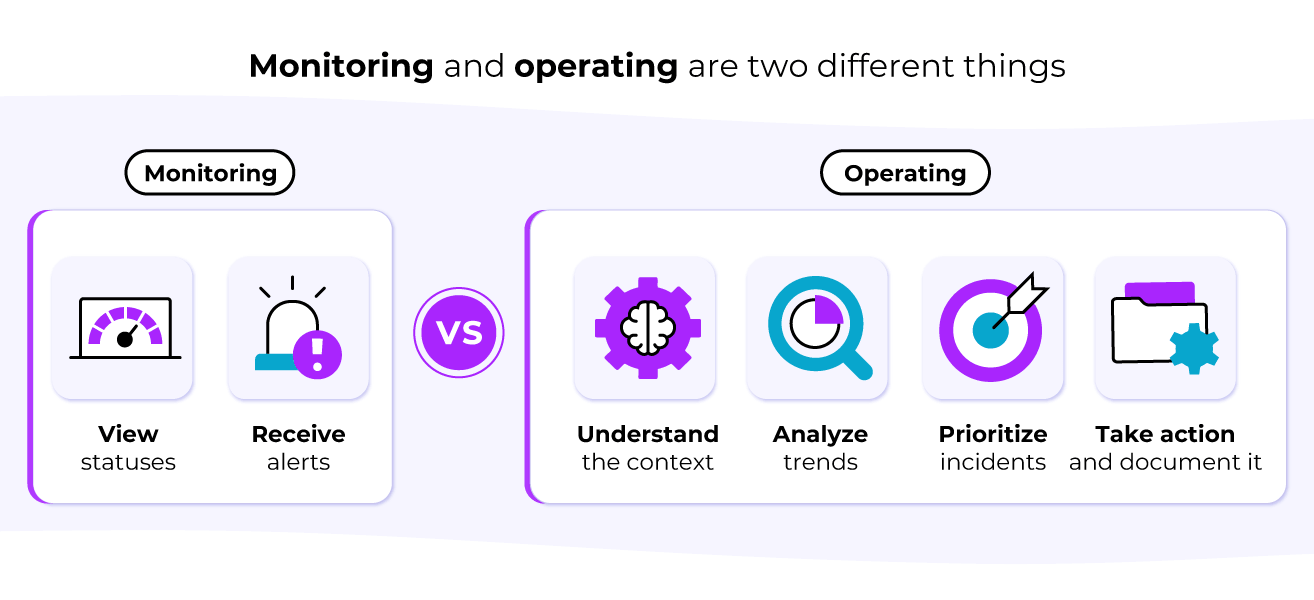
That is precisely the difference between monitoring and operating.
Monitoring means seeing statuses.
Operating means interpreting what those statuses mean in the real context of the network.
For a technical team, the important question is not only whether something is green or red. The question is what is happening, since when, with what trend, which users or services are affected and what priority it has compared with the rest of the open incidents.
A hotel network needs context, not just alerts
In a complex network, isolated alerts can create more noise than value.
An alert without context forces the technician to manually reconstruct the situation: check the device, find its location, review configurations, look at history, check connected clients, see whether there are related tickets and, in many cases, access several different tools before being able to make a decision.
That reconstruction time is one of the major hidden costs of network operations.
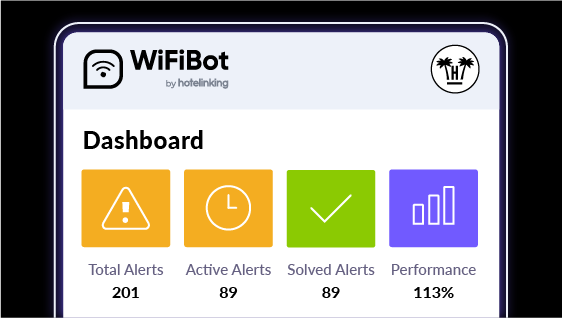
Our new WiFiBot takes a different approach: bringing service, client, connection and device metrics into the same view, including history and trends. This allows the technical team to distinguish between a one-off incident and structural deterioration, prioritise based on data and avoid depending solely on the latest complaint received.
This is especially important in hotels, where the end user’s perception can arrive late or be expressed imprecisely: “the WiFi is bad”, “the internet keeps dropping”, “it does not work in this area”, “it has been slow since yesterday”.
Translating that perception into a technical cause requires data.
And not just any data, but data connected to each other.
From technical data to operational decisions
An operations platform should not be limited to displaying metrics. It should help teams make decisions.
For example:
- If several access points on one floor show a higher-than-usual load, the problem may be related to capacity planning or client distribution.
- If the optical power of an ONT degrades progressively, an intervention can be planned before the outage occurs.
- If a service fails repeatedly during a specific time slot, the history makes it possible to detect patterns.
- If a configuration has drifted away from the standard, it can be compared with a stable version and corrected.
- If an incident affects several clients or areas, it should be prioritised differently from an isolated case.
The key is not just seeing more information, but seeing the right information at the right time.
That is where a single dashboard stops being just a dashboard and becomes a real operations tool.
Fewer scattered tools, greater operational continuity
Many incidents do not last longer because they are technically complex, but because the information is scattered.
One technician checks the monitoring tool. Another looks up credentials in a spreadsheet. Someone searches for the building floor plan. Another connects to the device through a terminal. The history is in an old ticket. The correct configuration is saved somewhere else. And part of the knowledge depends on a specific person remembering how that installation was deployed.
That model works while the team is small, the network is simple and incidents are few. But it becomes fragile as the number of hotels, devices, services and people involved grows.
WiFiBot centralises operations in a single platform: monitoring, metrics, documentation, configurations, terminal access, history, alerts and automations. According to the technical brief, the goal is to reduce operational friction by concentrating visibility, automation and documentation in one place.
This does not only improve response speed. It also improves service continuity when the team changes, when an external provider is involved or when an incident needs to be escalated to another technical level.
Operating with history changes the conversation
One of the major limitations of basic monitoring is that it usually shows a snapshot of the moment.
But many important incidents do not appear suddenly. They build up gradually.
The optical signal gets worse over several days.
An access point becomes saturated at the same time every day.
A link loses performance during certain time slots.
A configuration starts to differ from the standard.
One area of the hotel accumulates recurring complaints.
Without history, every incident looks new. With history, patterns emerge.
And when patterns emerge, the technical team can stop working only in reactive mode.
This even changes the conversation with other teams, providers or operators. It is no longer about explaining a perception, but about showing an evolution: when the problem started, how it has changed, which devices it affects, which metrics prove it and what impact it has on the service.
In network operations, that difference is huge.
Anticipating issues before the guest calls
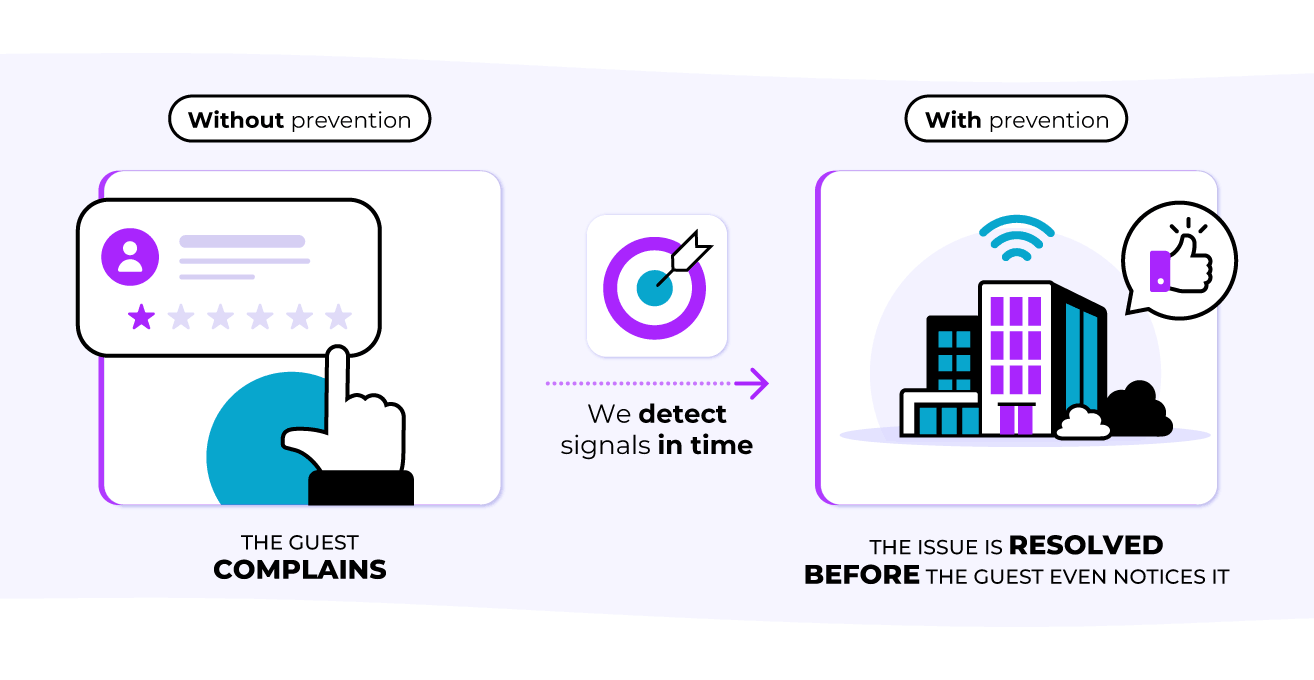
In hospitality, many incidents are detected late: when the guest complains, when reception reports it, when calls pile up or when the problem is already affecting the customer experience.
But in many cases, the network had already shown signs beforehand.
A platform like WiFiBot makes it possible to work with those signals: event correlation, normal behaviour baselines, progressive deterioration, performance changes, contextualised alerts and metrics that help detect problems before they escalate.
The goal is not only to respond faster. It is to reduce the number of incidents that reach the end user.
That is one of the fundamental differences between monitoring a network and operating it with judgement.
A hotel network is not managed only from the NOC
Another important point is that network operations in hotels do not always depend on a single specialised technical team.
IT managers from the chain, external maintainers, the hotel’s technical staff, connectivity providers, installers or different levels of support teams may all be involved.
That is why the tool needs to help share context.
It is not enough for one expert to know how to interpret the network. The platform must ensure that every intervention has enough information: device location, current status, history, configuration, associated services, documentation and traceability of changes.
When all that knowledge is centralised, operations depend less on calls, internal memory or scattered documentation.
The real value: prioritising with data
Not all incidents have the same impact.
An isolated alert on a secondary device should not be treated in the same way as progressive degradation in a critical area of the hotel. A one-off problem does not require the same response as a sustained trend. An individual complaint should not carry more weight than a metric that shows recurring saturation across an entire floor.
The value of an operations platform lies in helping teams prioritise.
And prioritising well requires three things:
- First, full visibility of the network and the services that depend on it.
- Second, enough history to distinguish what is one-off from what is structural.
- Third, operational context to understand the real impact of each event.
Without that, the team ends up acting based on perceived urgency. With it, the team can act based on real impact.
WiFiBot: a platform for operating, not just looking
WiFiBot was created precisely to cover that space between traditional monitoring and real network operations.
From a single interface, it allows teams to visualise, manage and automate infrastructure elements, including GPON, WiFi, switching, VoIP, services, connected clients, configurations, alerts, documentation and historical metrics. The product proposal highlights that WiFiBot makes it possible to operate, monitor and automate any element of the network from a single interface, reducing intervention time and providing full visibility of the site.
This turns the dashboard into more than a status view.
It turns it into an operational control point.
A place from which the team can see what is happening, understand why it is happening, act on the network, document the intervention and maintain traceability of what has been done.
Conclusion: green is no longer enough
A hotel network can appear to be green and still be showing signs of deterioration.
- It may have active devices and clients with a poor experience.
- It may have operational links and affected services.
- It may have closed alerts and unresolved recurring problems.
- It may have documentation, configurations and knowledge spread across too many places.
That is why operating a modern hotel network requires more than a monitoring dashboard.
It requires real visibility, history, context, automation and traceability.
The challenge is no longer just knowing whether the network is on. The challenge is knowing how it is behaving, what is changing, what could fail and what decisions the technical team needs to make before the problem reaches the guest.
That is the shift that marks the difference between looking at a network and truly operating it.
Frequently asked questions about hotel networks
- Why is it not enough to know whether devices are green?
Because a device can be active and still deliver a poor experience. There may be saturation, loss of performance, optical degradation, configuration issues or recurring incidents that do not appear in a basic status view.
- What is the difference between monitoring a network and operating it?
Monitoring means seeing statuses and alerts. Operating means interpreting that data in context, understanding trends, prioritising incidents, acting on the infrastructure and leaving traceability for every intervention.
- What does WiFiBot offer compared with a traditional dashboard?
WiFiBot brings metrics, history, alerts, documentation, configurations, automations and operational context together in a single platform. This enables better-informed technical decisions and reduces dependence on scattered tools.
- Why is history important in a hotel network?
Because many incidents do not appear suddenly. Optical degradation, access point saturation or loss of performance usually evolve over time. History makes it possible to detect patterns and anticipate problems before they affect the guest.
- Is WiFiBot designed only for WiFi networks?
No. Although its name refers to WiFi, WiFiBot is designed to operate different elements of the network infrastructure, including GPON, WiFi, switching, VoIP, services, connected clients, configurations and alerts.
Would you like to see how WiFiBot can help you operate your network with greater visibility, fewer manual tasks and a stronger ability to anticipate issues?
Request a technical demo and discover how to centralise the operation of your network infrastructure in a single platform.