Intelligent hotel loyalty: data, CRM and automation to increase direct bookings
Hotel loyalty no longer depends only on discounts or points programmes. Today, hotels can use first-party data, CRM and automation to better understand their guests, personalise communications and generate more direct bookings.
 Tomeu FiolCMO de Hotelinking
Want to see more of Hotelinking’s content on Google?
Hotel loyalty is one of the most effective ways to increase direct bookings and reduce dependency on commissioned channels. Getting a guest to book with the hotel again, and to do so through the direct channel, has a clear impact on profitability.
But building loyalty is no longer just about offering discounts or creating a points programme. Today, hotels need to know their guests better, work with quality data and use tools that make it possible to personalise the relationship with each customer.
This is where the integration and capture of quality data, hotel CRM, communication automation and, increasingly, the support of artificial intelligence tools that make it easier to activate that data come into play.
Why does loyalty help increase direct bookings?
Every time a guest books directly with the hotel again, the brand gains more than just another stay. It also gains independence from intermediaries, greater control over the customer relationship and a more complete database for future commercial actions.
OTAs remain important channels for capturing demand, but the hotel’s goal should be to turn part of that intermediated demand into direct, repeat customers.
To achieve this, it is not enough to wait for the guest to come back on their own. The hotel needs to maintain the relationship after the stay and offer clear reasons to book directly on the hotel’s official website.
Some of those reasons may include:
- exclusive benefits for repeat guests;
- better conditions when booking on the official website;
- personalised communications based on the guest’s history;
- offers adapted to the destination, season or type of customer;
- complementary experiences before, during or after the stay;
- digital loyalty programmes;
- reactivation campaigns for guests who have not booked for some time.
When well executed, loyalty turns a one-off stay into an ongoing relationship.
The value of data in hotel loyalty
To build loyalty, you first need to know the guest.
It is essential to collect as much information as possible about each guest and their companions: contact details, language, nationality, booking channel, stay history, preferences, behaviour, survey responses or interaction with previous campaigns.
This information is key to moving from generic communications to truly personalised actions.
Communicating with a guest who has just stayed at the hotel is not the same as communicating with one who has not booked for two years. Nor is it the same to speak to a customer travelling as a couple, a family or a corporate guest. Each profile needs a different message and the right moment of contact.
The more complete and reliable the hotel’s database is, the greater its chances of creating useful, segmented campaigns focused on conversion.
In addition, working with first-party data allows the hotel to reduce its dependency on third parties and build a more direct relationship with its customers.
Hotel CRM as the foundation of a loyalty strategy
Having data is not enough. It also needs to be organised, enriched and activated.
A hotel CRM allows the hotel to centralise guest information, create dynamic segments and automate communications based on behaviour or the stage of the customer lifecycle.
With a CRM, the hotel can identify, for example:
- repeat guests;
- customers who booked through an OTA;
- customers who have already booked through the direct channel;
- inactive guests;
- profiles with a high likelihood of returning;
- customers interested in a specific destination;
- users who have answered surveys;
- guests who have interacted with previous campaigns.
This segmentation makes it possible to send much more relevant messages. For example, a customer who booked through an OTA can receive a post-stay communication explaining the benefits of booking directly next time. A repeat guest can receive a campaign with exclusive benefits. And an inactive customer can enter a reactivation workflow.
Hotel CRM turns data into concrete actions.
From traditional CRM to a smarter CRM
The evolution of hotel CRM is not just about storing more data, but about being able to use it better.
For years, many hotels have understood CRM as a tool for storing customer information, creating segments and sending campaigns. All of this remains important, but today it is not enough if that data is not connected to the different moments and channels in the guest relationship.
A guest may interact with the hotel by email, WhatsApp, phone, chatbot, booking engine, PMS or surveys. If each channel works separately, the experience becomes fragmented and the hotel loses context.
This is why hotel CRM is evolving towards a more connected model, where guest data, bookings, communications and commercial opportunities can be managed in a more coordinated way.
At this point, artificial intelligence does not replace the loyalty strategy, but it does help make it more agile. It can facilitate contact classification, summarise interactions, detect commercial opportunities, suggest responses, identify the right moments to activate a communication or help maintain context when the guest changes channel.
It is not about implementing AI for the sake of implementing AI, but about using it as support to make the CRM more useful, faster and more actionable.
We explain this change in more detail in the article on how to move from a traditional CRM to an omnichannel CRM with AI, where we analyse how to connect conversations, bookings and management to provide a more coherent relationship with the guest.
Personalised communications to generate repeat stays
One of the most effective practices for building guest loyalty is to maintain contact through personalised and segmented communications.
The goal is not to send more emails, but to send better messages: more relevant, more timely and more aligned with the guest’s interests.
Some examples of useful communications include:
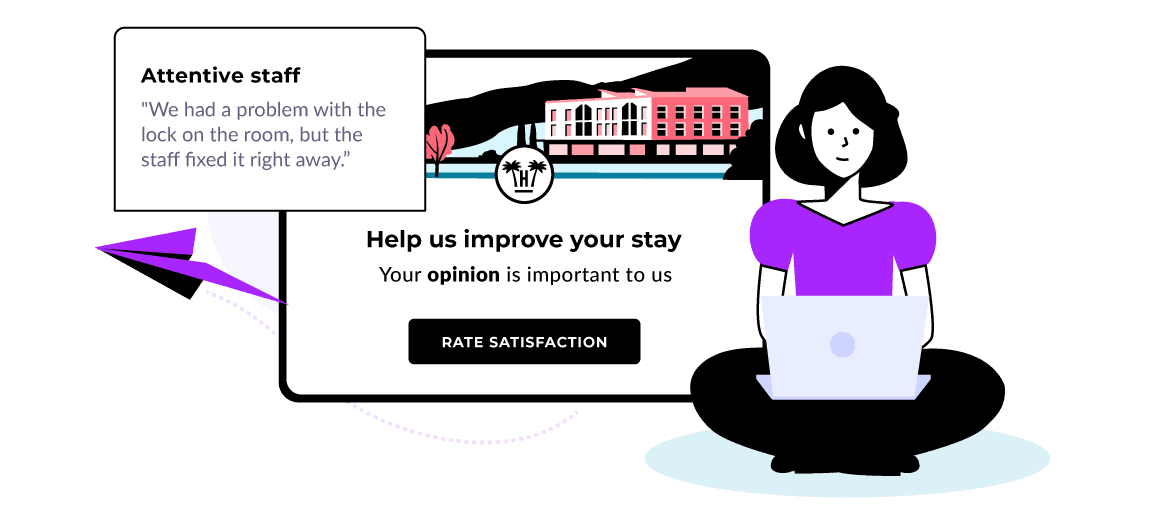
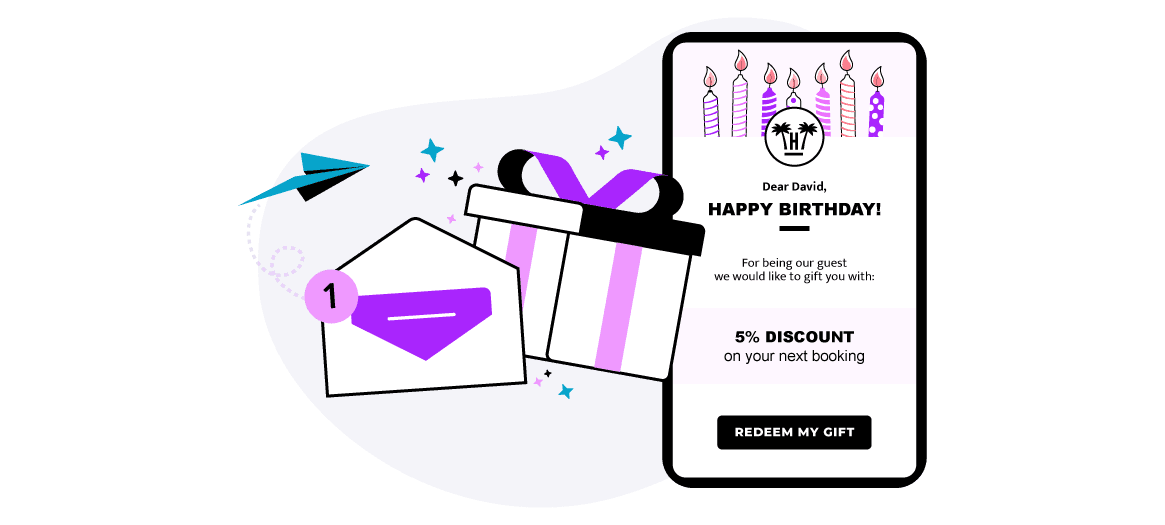
- a post-stay email with a thank-you message and a benefit for booking direct;
- a campaign to turn OTA guests into direct customers;
- a personalised message for repeat guests;
- a segmented promotion for low season;
- campaigns by destination or type of hotel;
- reminders before key dates;
- communications linked to a loyalty programme;
- recommendations based on stay history.
Personalisation helps guests perceive the communication as useful, not as a mass promotion. And that difference is key to keeping the relationship with the brand alive.
Automation: building loyalty without increasing operational workload
For a long time, many loyalty actions have been managed manually: preparing lists, creating campaigns, selecting recipients and scheduling sends.
That model can work for one-off actions, but it is not scalable.
With a hotel CRM, many communications can be automated based on specific events: a confirmed booking, a completed stay, a survey response, an inactive customer or a new direct sales opportunity.
Automation makes it possible to activate campaigns such as:
- welcome messages for new contacts;
- pre-stay communications;
- post-stay emails;
- campaigns for repeat guests;
- reactivation of inactive customers;
- workflows for customers coming from OTAs;
- loyalty campaigns by segment;
- actions based on surveys or satisfaction.
And thanks to the support of AI tools, some of these automations are becoming easier to configure and optimise. AI can help interpret data, detect patterns, prioritise segments or suggest the most appropriate next step within a communication.
This means the marketing team does not always have to start from scratch or manage every action manually. CRM remains the foundation of the strategy, but AI can help activate that data with greater speed and precision.
Automation does not mean losing closeness. On the contrary: when it is supported by good data, correct segmentation and a well-connected CRM, it makes it possible to send more relevant communications at the right time.
Loyalty and profitability: measuring beyond the booking
Loyalty should not be measured only by the number of campaigns sent or the email open rate.
To understand whether the strategy is working, the hotel should analyse indicators such as:
- direct bookings generated;
- revenue attributed to campaigns or workflows;
- guest repeat rate;
- conversion of OTA customers to the direct channel;
- best-performing segments;
- unsubscribe rates;
- engagement with communications;
- evolution of the database;
- customer lifetime value.
The ultimate goal is to build a profitable and sustainable relationship with the guest.
A good loyalty strategy helps the hotel sell more directly, reduce intermediation costs and improve the customer experience over time.
How to start working on hotel loyalty
To get started, it is not necessary to create a complex strategy from day one. The important thing is to build a solid foundation.
These would be the first steps:
- Review the quality of the database.
- Identify the main guest segments.
- Define which customers are worth activating or recovering.
- Create useful communications for each moment in the guest lifecycle.
- Automate the most important workflows.
- Measure results and optimise campaigns.
From there, the hotel can gradually incorporate more advanced automations and rely on AI tools to make the management of segments, communications and commercial opportunities easier.
Hotel loyalty works best when it stops being a one-off action and becomes an ongoing strategy.
From hotel guests to direct customers
Every guest who passes through a hotel represents an opportunity for a long-term relationship. But to take advantage of it, the hotel needs to capture data, organise it properly and activate relevant communications.
Modern hotel loyalty is based on first-party data, CRM and automation. And, increasingly, on AI tools that help interpret that data better and facilitate actions that used to depend too heavily on manual work.
Thanks to these tools, hotels can know their customers better, personalise their campaigns and increase direct bookings without relying solely on isolated actions or manual processes.