Hotel network deployments without carry-over errors: from manual configuration to automatic provisioning
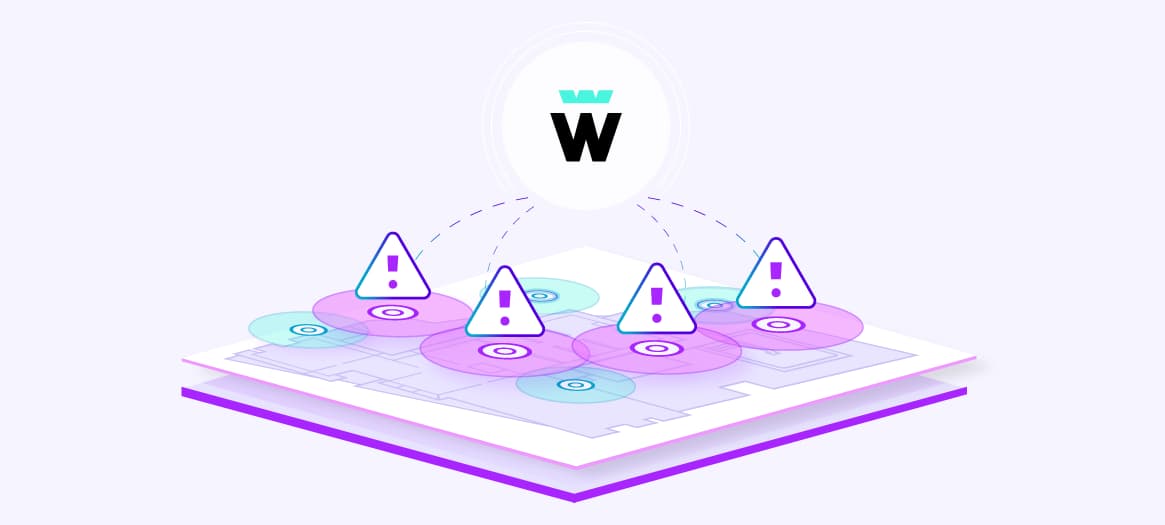
In a hotel network deployment, configuration errors are not always caught on the spot. They linger. They surface in production, once the hotel is already operational and any intervention carries a higher cost. WiFiBot provides visibility from the OLT throughout the deployment, applies templates automatically as new devices come online, and reduces the rework that manual configuration creates. The result: faster, more consistent deployments with fewer carry-over incidents.

Want to see more of Hotelinking’s content on Google?
In a network deployment, the most critical moment is not always the obvious one.
The physical installation can be planned, materials arrive on time, equipment is mounted, links come up. And yet, weeks or months after the hotel opens, incidents keep appearing that trace back to something that happened during the deployment: an ONT with the wrong profile, a misassigned VLAN, a service that was never properly configured, a device brought online without going through the standard process.
This is what network operations teams call a carry-over error.
It does not fail at the time of deployment. It fails in production, when the hotel already has guests, when any intervention carries a higher operational cost, and when reconstructing what happened during the installation means relying on memory, scattered notes or calls to whoever was on site.
The problem is not that people do poor work. The problem is that manual, staged configuration — without centralised visibility and without automation — creates conditions where errors accumulate unseen.
Manual deployment has a cost that is rarely measured
In a typical GPON deployment, the standard process goes roughly like this:
ONTs are installed room by room. The OLT is accessed to configure each port. Profiles, VLANs and services are assigned. What has been done and what remains is noted in a spreadsheet, a shared document, or simply held in the engineer’s memory. And in parallel, as the installation progresses, changes, corrections and adjustments are made that are not always recorded consistently.
The result is that by the end of the deployment, no one has a complete and reliable picture of how the network has actually been configured.
That is not a problem of intent. It is a structural problem of the process.
When configuration is done manually, in stages, with multiple people involved and without a platform that centralises the actual state of the network, inconsistency is practically unavoidable.
And the inconsistency introduced at deployment time is exactly what generates the errors that surface in production.
Visibility from the first connected device
One of the most important differences between a deployment with and without the right tool is when the technical team gains real visibility into what is happening.
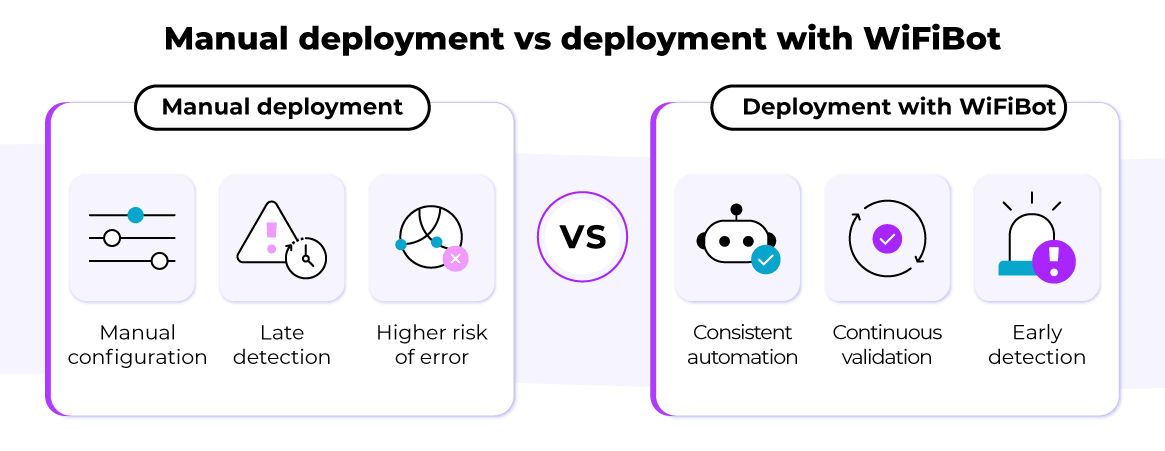
In a manual deployment, visibility comes late. Work proceeds on what has been configured, trust is placed in it being correct, and the problem is discovered when something stops working in production.
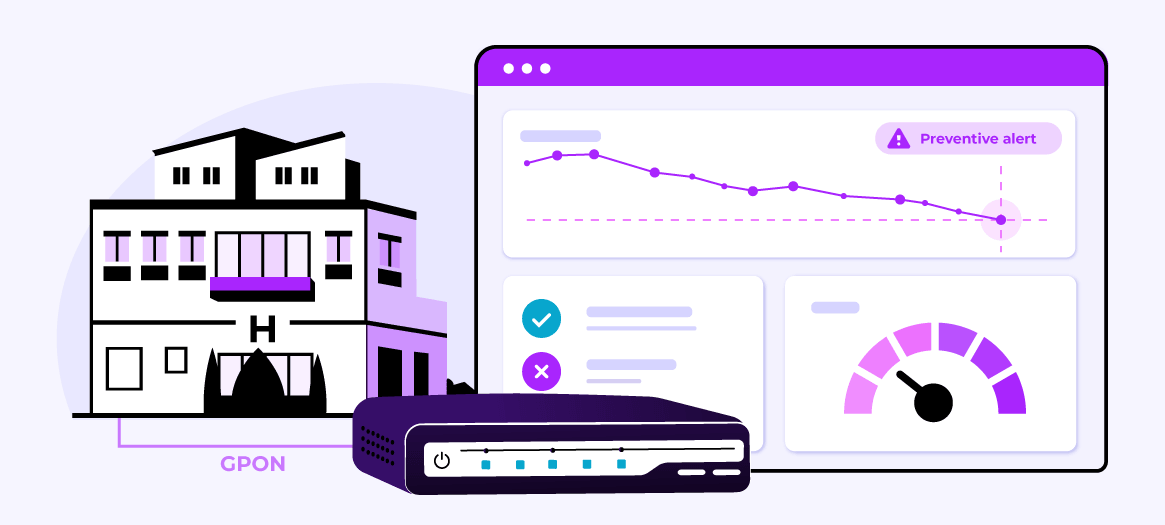
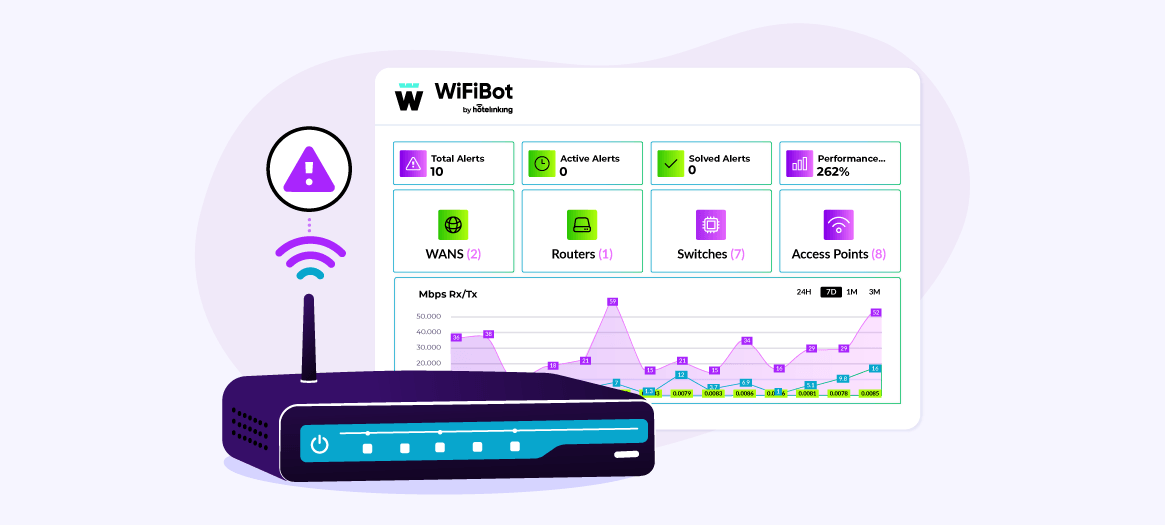
Our intelligent platform WiFiBot provides visibility from the OLT throughout the deployment. This means that from the moment the first device connects, the technical team can see what is on the network, what state it is in, and whether the configuration is consistent with what it should be.
This visibility has an immediate effect: configuration errors are caught during deployment, not after.
Fixing a wrong profile while the network is still being installed is not the same as fixing it once the hotel is operational. The effort is the same. The impact is not.
Furthermore, real-time optical power monitoring during installation allows physical problems to be identified from the outset: a poorly terminated fibre, a connector with excessive loss, an ONT operating at its limit from day one. Catching this at installation time is far less costly than catching it after a guest complaint.
Auto-provisioning eliminates human variability
The most significant step that changes the way deployments are carried out is auto-provisioning.
When a new ONT is connected, WiFiBot detects it automatically and applies the corresponding profile according to predefined rules. Onboarding goes from a manual process — with all the steps that entails — to an automatic and consistent one.
This has direct consequences for deployment quality:
- Every device is configured in exactly the same way, following the same template, without depending on each engineer applying the correct parameters in the correct order.
- Onboarding time is drastically reduced. What previously took minutes of manual work per room now takes seconds. In a 200-room installation, that is a very significant difference in total deployment time.
- Configuration is recorded from the very first moment. There is no need to reconstruct which profile each ONT has afterwards. It is in the platform, with full history, from the moment it was connected.
- Any engineer can complete the deployment correctly. Knowledge does not depend on the person who set up the first installation being present. The logic lives in the platform.
Templates as an operational standard
Configuration templates are one of the elements that most contribute to reducing carry-over errors — but only if they are applied consistently.
In a manual process, templates exist, but their application depends on each engineer. They may be applied correctly, applied with minor variations, applied on top of devices that had prior configurations that were not properly cleared, or skipped entirely under the pressure of a tight deployment schedule.
With WiFiBot, templates are not a reference document the engineer consults. They are the mechanism that runs automatically when a device joins the network.
This means the standard configuration is always applied identically, regardless of who is carrying out the installation, whether it is the first hotel or the tenth, whether the engineer is familiar with that type of installation or is working in that environment for the first time.
Consistency is not the result of everyone doing their job perfectly. Consistency is the result of the process guaranteeing it.
ONT replacement without a specialist engineer
One of the scenarios that best illustrates the value of auto-provisioning is not the initial deployment. It is the replacement of an ONT in production.
In a hotel network, ONTs are replaced with some regularity: device failure, physical damage, fleet upgrades. And each replacement requires, in a manual process, a technical intervention to configure the new ONT with the same parameters as its predecessor.
That intervention, though routine, requires OLT access, knowledge of the correct parameters and the time of a qualified engineer. In many cases it involves a site visit or coordination with the hotel’s team that extends the resolution time.
With WiFiBot, ONT replacement can be carried out by the hotel’s own maintenance staff, without specialist technical knowledge. The new device is connected, WiFiBot detects it, identifies it as a replacement and applies the correct profile automatically. The service is restored without waiting for an external engineer.
This completely changes the maintenance workflow. What was previously an incident requiring specialist technical intervention becomes a task the hotel’s own team can resolve in minutes.
Fewer site visits, less rework
One of the strongest arguments for automating provisioning is not technical — it is economic.
Every avoided site visit has an associated cost: engineer time, travel, coordination with the hotel, impact on other ongoing work. For a maintenance company with several active installations, the total of those avoidable trips represents a significant portion of operational cost.
Rework carries a similar cost. Fixing in production an error that could have been caught during deployment does not only cost more in time. It costs more because hotel coordination is required, because guests are affected, because the intervention has less room to manoeuvre, and because the reputation of the service is on the line.
WiFiBot does not eliminate the need for site visits or interventions. What it does is concentrate those interventions in more controlled moments, with more information available and less urgency.
That is the difference between intervening because something has failed and intervening because the platform has detected that something may fail.
Provisioning as part of continuous operations
Deployment is not a one-off event. It is the start of an operation that will run for years.
The way the network is configured during deployment therefore has long-term consequences. A network properly provisioned from the start — with consistent templates, full history from day one and centralised visibility — is far easier to operate, maintain and scale.
A network built with inconsistent manual configurations, without centralised documentation and with errors carried over from deployment, accumulates technical debt that will eventually need to be resolved.
WiFiBot integrates provisioning within continuous network operations. The ONTs configured during deployment are the same ones monitored in production, with the same history, the same alerts and the same visibility as the rest of the infrastructure. There is no separate tool for deployment and another for operations. It is the same platform throughout the entire lifecycle of the installation.
This reduces friction between the team that carries out the deployment and the team that will maintain the network. Context is not lost. Configuration does not need to be reconstructed. History starts from day one.
Conclusion: rework is not inevitable
In a hotel network deployment, carry-over errors are taken for granted.
It is assumed there will be things to correct later, configurations to review in production, incidents whose root cause lies in the initial deployment. It is treated as inherent to the process, not as something that can be avoided.
But it is not inevitable.
It is the result of a manual process — without automation, without centralised visibility, and without a mechanism that guarantees configuration consistency from the first connected device.
Automating provisioning, applying templates systematically and having real visibility from the start of deployment is not added complexity. It is simply the way to run deployments that generate fewer problems afterwards.
The rework that is not generated during deployment is time the technical team does not have to spend resolving incidents in production. And that time, accumulated across an installation, across a portfolio of hotels, across a year of operations, has very concrete value.