
Automating the repetitive: freeing your technical team from mechanical network incidents
Much of the day-to-day incidents on a hotel network are repetitive and well known: a device that needs a reboot, a configuration that has drifted from the standard, an ONT that needs replacing in a room. WiFiBot automates the resolution of these cases —reboots, reconfiguration and equipment replacement— and lets the hotel’s own staff resolve incidents that previously meant waiting for an external technician.

On any hotel network, a large share of the incidents that come in every day are no mystery.
A device that has frozen and needs a reboot. An ONT that has been swapped in a room and needs to be registered again. A configuration that, for whatever reason, has drifted from the standard. A device that has reset itself —sometimes after a power cut, sometimes because of a guest or a member of staff— and lost its profile.
None of these cases calls for investigation. You know what has happened, you know what needs doing and, most of the time, you even know how it will be resolved before you so much as look at the device.
The problem isn’t technical difficulty. It’s the time they consume.
And that time, multiplied across dozens or hundreds of hotels, is one of the biggest hidden costs of running a network.
Mechanical incidents: the work that shouldn’t depend on one person
There is a type of incident that recurs with very clear patterns:
- A device stops responding and needs a power-cycle.
- An ONT is replaced in a room and has to be recognised and given a profile.
- A device resets and loses its configuration.
- A device starts operating with parameters different from those defined as standard.
In all these cases, the solution is known in advance. There’s no need for diagnosis, no need for expert judgement, no need to escalate to a higher level.
And yet, in many operations, each of these cases still goes through the same hands that resolve the genuinely complex incidents.
That isn’t a problem of technical capability. It’s a problem of operational design.
When replacing an ONT shouldn’t wait for an external technician
One of the clearest examples is replacing an ONT in a room.
In the traditional model, changing an ONT means coordinating a technical visit, waiting for availability, travelling to the hotel, swapping the device, registering it manually and applying the right profile. All that for a hardware change that is, in itself, simple.
With WiFiBot, that process changes at its root: the hotel’s own technical staff can replace the ONT with no need for an external technician. WiFiBot recognises the new device the moment it connects, applies the corresponding profile and restores the service in a matter of seconds.
The room has its service back without depending on an external maintenance provider’s schedule, without generating a call-out and without the incident having to escalate beyond whoever is already on site.
This isn’t about doing away with specialist technical staff. It’s about reserving them for what genuinely needs them.
Reboots, power-cycles and reconfiguration: the repetitive, resolved without waiting
Replacing equipment is just one scenario. There are others just as frequent:
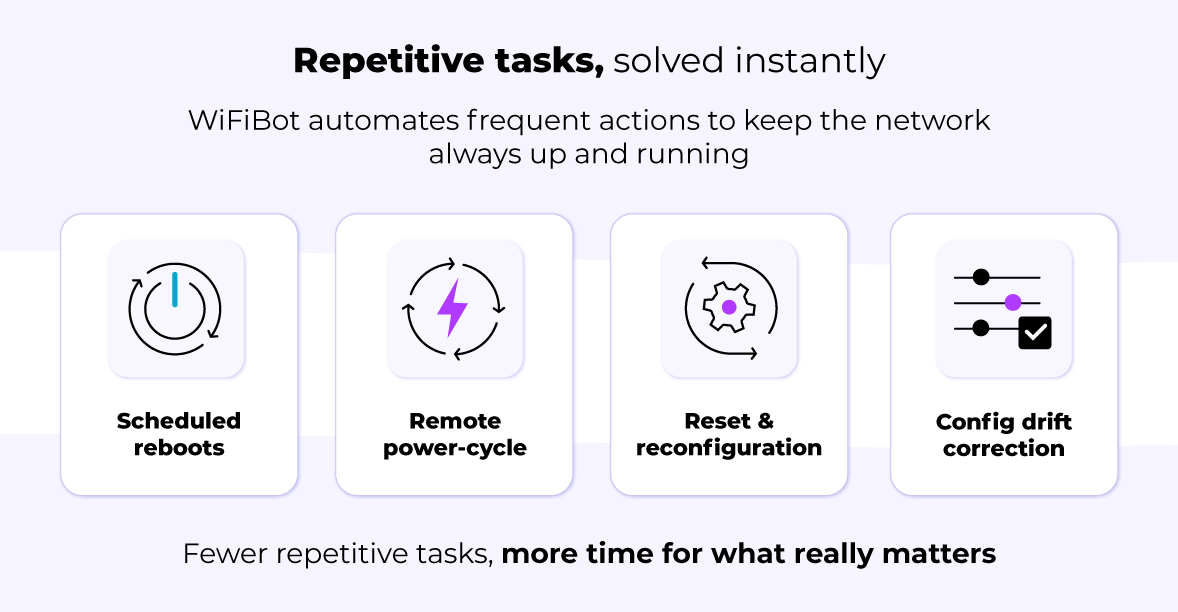
- Scheduled reboots of devices that need them periodically, without relying on someone remembering or running them manually.
- Remote power-cycle when a device stops responding, with no need for a site visit.
- Automatic reset and reconfiguration when a device has reset —due to a power cut, tampering or any other cause— and lost its configuration.
- Correction of deviations when a device is operating with parameters different from the standard defined for that profile or installation type.
In every case, the logic is the same: if the problem is known and the solution is known, it shouldn’t depend on a person spotting it, diagnosing it and running it manually every time.
The more incidents that follow this pattern, the greater the volume of mechanical work you can remove without touching service quality.
A rules engine, not a fixed checklist
Every network has its own particularities. What counts as a mechanical incident on one installation may not on another, and what is resolved manually today can be automated tomorrow.
That’s why automation can’t be approached as a closed set of predefined rules.
WiFiBot includes a workflow and automation engine that lets you define custom actions —alerts, reboots, escalations, notifications— according to each site’s operating logic. Every installation can have its own rules: what is resolved automatically, under what conditions, and at what point an incident stops being mechanical and starts requiring human judgement.
This makes automation something that adapts to the real operation, not the other way around.
What the technical team gains when it stops resolving the same thing over and over
The benefit isn’t just resolution speed. It’s where the team’s time goes.
When mechanical incidents resolve themselves, the technical team is no longer tied up in tasks that don’t require its judgement and can spend that time on what does:
- Analysing trends and gradual degradations.
- Investigating incidents that don’t fit a known pattern.
- Prioritising interventions by real impact.
- Improving the infrastructure rather than just maintaining it.
A team that spends its day handling reboots and ONT registrations has no time to run the network with judgement. A team that automates the repetitive does.
That difference is especially noticeable when managing several hotels at once: what is a saving of minutes on a single installation becomes hours of technical work recovered every week across a chain.
Automating isn’t giving up control
Automating the repetitive doesn’t mean losing visibility over what happens.
Every reboot, every ONT replacement, every automatic reconfiguration is logged: what happened, when, on which device and with what result. The technical team keeps full traceability even over what it no longer has to run by hand.
This matters because automation only adds value if it’s transparent. If an automatic action fails or repeats with an unusual frequency, that information must remain available to the team, just as it would if a person had carried it out.
This isn’t about automating and losing sight of the network. It’s about automating without ceasing to run it with judgement.
Conclusion: the mechanical shouldn’t consume the time of the important
On a hotel network, many incidents don’t require an expert: they require someone —or something— to carry out the right action at the right moment.
Reboots, power-cycles, ONT replacements and correcting drifted configurations are cases where the solution is known in advance. Automating them doesn’t reduce the value of the technical team: it frees them for the incidents that do require their judgement.
The challenge isn’t having a team capable of resolving any incident. The challenge is making sure that team doesn’t spend its time resolving the same ones over and over.
And that is one of the clearest differences between an operation that reacts to every alert and one that has automated what it already knows how to resolve.
Frequently asked questions about network incident automation in hotels
- What is a mechanical incident on a hotel network?
It’s a repetitive, well-known incident whose cause and solution don’t require expert diagnosis: a device that needs rebooting, an ONT that has to be replaced and registered, or a configuration that has drifted from the standard.
- How does WiFiBot allow an ONT to be replaced without an external technician?
WiFiBot automatically recognises the new ONT the moment it connects, applies the corresponding profile and restores service in seconds. This lets the hotel’s own technical staff carry out the replacement without waiting for an external visit.
- What kind of actions can WiFiBot automate?
Scheduled reboots, remote power-cycles, automatic reset and reconfiguration of devices that have reset or drifted from the standard, plus custom workflows with alerts and escalations according to each site’s rules.
- Does automating incidents mean losing visibility over the network?
No. Every automatic action is logged with its history: what happened, when, on which device and with what result. The technical team keeps full traceability even when the action runs without manual intervention.
- What does the technical team gain by automating the repetitive?
Time. By no longer resolving known incidents manually, the team can focus on analysing trends, investigating atypical cases and prioritising interventions by real impact, instead of mechanical tasks.
Let the network fix itself whenever it can.
With WiFiBot you can automate reboots, reconfigurations and equipment replacements, freeing your technical team for the work that truly requires judgement.