

Anonymous visitors on your hotel website: how to turn that traffic into actionable data
Most of the traffic reaching a hotel website leaves without a trace. We explain what an anonymous visitor is, why it’s the missing piece in a first-party data strategy, and how a hotel CDP turns that behaviour into real campaigns and guest relationships.

For every 100 people who visit a hotel website, between 97 and 98 leave without providing any identifiable data, and only between 1.5 and 2.5 go on to complete a booking. A further 40% start a booking and abandon it before completing payment.
For a general manager or marketing manager, this isn’t just an analytics curiosity — it’s traffic that has already been paid for, through SEO, paid search or brand investment, and that is being lost along the way. Much of that demand that leaves without identifying itself will still end up booking somewhere, but often through an OTA, which will take between 15% and 30% commission on that booking. It’s the usual paradox: the hotel attracts the visit, but the external channel keeps the margin.
What exactly is an anonymous visitor?
An anonymous visitor is anyone who lands on the hotel or chain’s website without identifying themselves: they haven’t booked, filled in a form or connected to the WiFi. From a technical standpoint they exist — there’s a session, a behaviour, a set of pages viewed — but from a commercial standpoint they’re invisible. The hotel has no way of knowing whether this is a returning guest, someone comparing against the competition, or a guest who is about to book.
That unidentified session, however, holds valuable information: which pages were visited, how long was spent on each one, whether they looked at specific room types or the weddings and events section, whether they came back several times within the same week. In other words, there is a detectable intent, even before any name or email address is attached to it.
Why this traffic matters more than ever
Three factors are pushing hotels to pay attention to traffic that, until recently, was simply discarded:
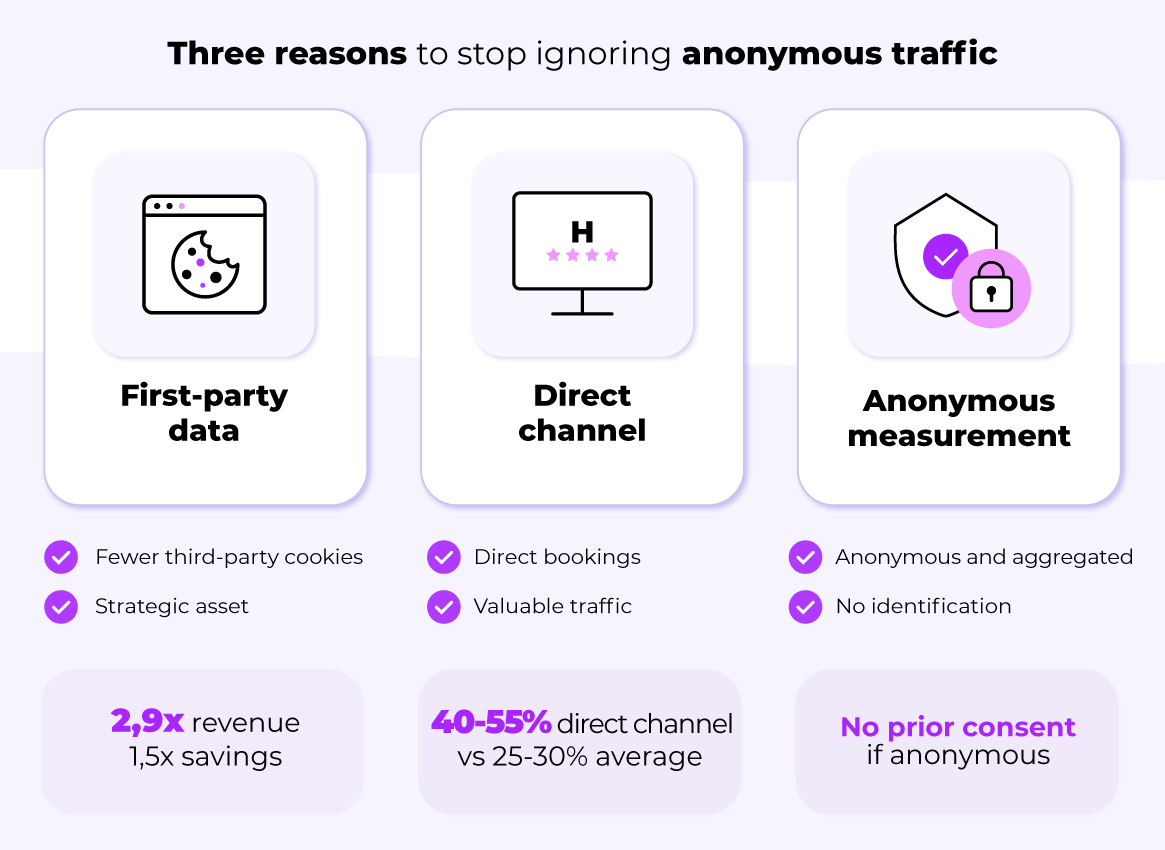
The decline of third-party cookies. Advertising platforms no longer hand over audience targeting as easily as before, and privacy regulation keeps tightening. First-party data has become the strategic asset of hotel marketing for 2026: hotels that have already implemented a first-party data strategy report, on average, a 2.9x revenue lift and 1.5x cost savings, according to a Sojern survey of hotel executives worldwide (Hotelinking).
The rising cost of OTA dependency. Leading independent hotels now achieve between 40% and 55% of their volume through their own channel, compared with an industry average of 25% to 30%. The gap between the two rarely comes down to traffic volume — it comes down to the ability to turn that traffic into a relationship, rather than a one-off booking.
Privacy is no longer an obstacle — it’s a design condition. The good news is that identifying behaviour at an aggregate, anonymous level doesn’t require the same legal treatment as identifying an individual. In Spain, the data protection authority (AEPD), in line with the EU’s GDPR, exempts aggregate and anonymous audience-measurement tools from prior consent requirements, provided they don’t cross-reference data between sites or identify the specific visitor — a position consistent with data protection guidance across the EU and UK (SecurePrivacy). The legal tipping point isn’t “observing behaviour”, it’s “linking that behaviour to an identity” without a lawful basis for doing so.
How this traffic is identified, without compromising visitor privacy
Systems that work with anonymous traffic typically combine several techniques: first-party domain cookies, behavioural session clustering, and AI models that score purchase intent based on pages viewed, visit frequency and content consumed. Realistic match rates for linking a session to a specific identity sit between 30% and 75%, depending on the sector and the data available — far from the 90%+ that some vendors occasionally claim (Factors.ai).
In hospitality, the most sensible approach — and the one that avoids any legal friction — isn’t to forcibly “de-anonymise” visitors, but to categorise behaviour in aggregate (what type of interest that visitor is showing: family, weddings, weekend getaways, business) and wait for the moment the visitor identifies themselves voluntarily: by filling in a form, connecting to the hotel’s WiFi, or completing a booking. At that point, the entire anonymous behavioural history can be linked to their profile, without it ever having been treated as personal data beforehand.
From anonymous visitor to named guest: the opportunity
The real value isn’t in knowing that “an anonymous visitor looked at double rooms three times this week” — it’s in what can be done once that person identifies themselves: at that point the hotel already knows they’re interested in a specific room type, that they’ve compared prices for particular dates, or that they’ve shown interest in a specific service. That information makes it possible to send a relevant message instead of a generic campaign, and to decide, with real evidence, who is worth targeting with media spend (Google, Meta), because they’ve already shown genuine intent, rather than starting from scratch with cold audiences.
How GuestMaker addresses this
Within the GuestMaker CDP, the Web Visitors module follows exactly this logic:
- A tracking script is installed on the chain’s website.
- AI categorises the browsing behaviour of each anonymous session by interest.
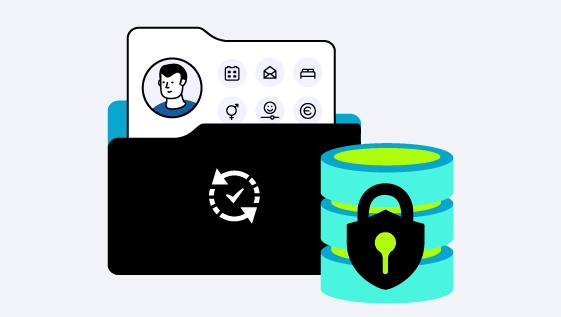
- As soon as that visitor reveals themselves — by filling in a form, connecting to the captive portal, or completing a booking — their browsing history is automatically merged into their CRM profile.
- From there, that detected behaviour can be used to segment audiences, build specific journeys, or decide which interest-based campaign makes sense to send them, all within the hotel’s own data ecosystem, without relying on third-party cookies or external platforms to know what each guest is interested in.
If you’re already working with a CDP, or considering adding one, this is one of the modules that tends to get overlooked — and one of the fastest to prove its value: it turns traffic that is currently written off as “lost” into the starting point for the next campaign.
Frequently asked questions about the importance of anonymous visitors on your hotel or chain's website
- Is it legal to identify anonymous visitors on my hotel's website?
Yes, provided the processing is limited to analysing behaviour in an aggregate, anonymous way until the visitor identifies themselves voluntarily (via a form, WiFi, or booking). Linking a session to a specific person without that action would require a specific legal basis, so the recommended approach is to wait for self-identification.
- Do I need to ask for cookie consent for this?
For aggregate, anonymous measurement, Spanish regulation exempts prior consent, in line with the wider EU/UK approach to analytics cookies. Once the data is linked to an identified person (after a booking, for example), it’s treated the same as the rest of the hotel’s guest data, under the same legal bases the hotel already applies in its CRM.
- How is this different from Google Analytics?
Google Analytics measures traffic and behaviour in aggregate, but it doesn’t connect that information to the guest’s profile in the CRM, nor does it automatically link it once that visitor identifies themselves. The difference lies in activation: moving from “knowing which pages were viewed” to “knowing it was that specific guest, and being able to target them with a campaign.”
- Does this work for chains with multiple brands or websites?
Yes. Tracking can be deployed across all of the chain’s websites, and the detected behaviour is centralised into a single customer profile, regardless of which hotel or brand the visitor browsed.
- What happens to visitors who never identify themselves?
Their behaviour is kept as aggregate, anonymous data, useful for understanding general interest trends (what’s searched for most, which pages generate the most interest), but it isn’t linked to any individual or activated on a personal level.
- How does this connect with my CRM or booking engine?
In GuestMaker’s case, anonymous behavioural data forms part of the same CDP that unifies bookings from every PMS and channel, so as soon as the visitor identifies themselves, their browsing history is available alongside the rest of their profile, with no additional integrations required.
Do you know how many of your anonymous visitors could become guests?
Find out how the GuestMaker CDP categorises anonymous traffic on your website and automatically connects it to your CRM as soon as that visitor identifies themselves.