
Beyond service: how to improve guest satisfaction in hotels
Guest satisfaction goes beyond service: it depends on when and how you collect their feedback. Discover how to improve it continuously and strategically.

Guest satisfaction is no longer just a simple indicator of quality; it has become a strategic element within hotel management. In an environment where online reputation directly impacts demand and where hotels increasingly rely on their own data, improving the customer experience is a competitive priority.
Today, it is not enough to offer good service. Hotels need to understand, measure and optimise every interaction with the guest throughout their entire journey.
From satisfaction to guest insight
Traditionally, hotels have measured satisfaction through post-stay surveys. However, this approach has clear limitations: low response rates, delayed information and limited ability to react. If a guest has had a bad experience, it is already too late to remedy it.
The most advanced hotel chains have gone a step further: they have moved from measuring satisfaction to turning it into actionable insights.
This involves:
- Collecting feedback at different points during the stay.
- Identifying patterns of behaviour.
- Detecting issues before they escalate.
- Implementing improvements in real time.
But it also involves something important: combining different types of surveys depending on the objective. Whilst real-time feedback allows you to take action during the stay, post-stay surveys remain key to delving deeper into specific aspects of the experience and gaining a more comprehensive view of customer satisfaction.
Types of satisfaction surveys
If a guest leaves the hotel without leaving feedback about their stay and other details, we are losing an opportunity that prevents any subsequent loyalty or sales strategy.
That is why it is important to find out how their stay is going during and also after their visit. The best way is to request their opinions digitally, so you can respond whenever you want and have all that information sorted and classified for further analysis.
1. During the stay surveys: detects unhappy customers and acts on time
Knowing what guests think while they are in-house is essential to improve the services and brand image. But we know that sometimes it is difficult to detect when a guest has a problem and is not enjoying their holiday at the hotel.
If you do not manage to solve it in time, you run the risk of the guest leaving feeling unhappy and therefore leaving a negative review on an online reputation channel. Sending a short survey while they are in-house can help fix the problem before leaving the hotel and avoid potential negative reviews.
In some cases, it can even increase guest satisfaction, as it demonstrates a proactive and hands-on attitude, which is highly appreciated.
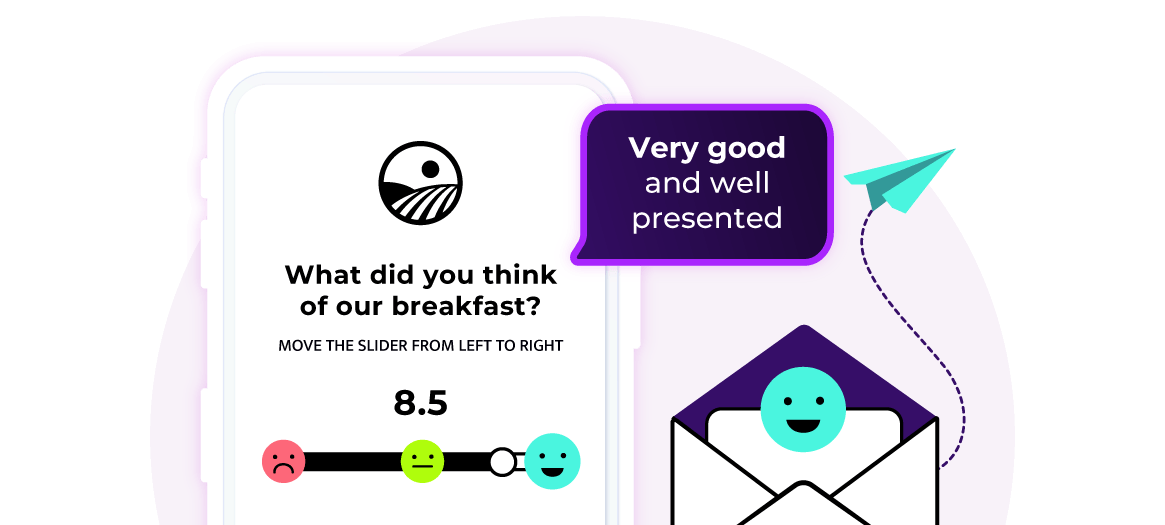
Our suite also has surveys specifically designed to collect guest impressions during their stay. The guest receives a personalised questionnaire in their language asking about their overall satisfaction and with a comments field.
One of these surveys’ most outstanding features is the possibility of setting a cut-off mark from 0 to 10.
Should the overall score of the survey be above the set score, the guest will be sent a review email to encourage them to leave a review on the main online reputation sites, making the most of their good opinion of the hotel.
Otherwise, if the score is below, it is possible to send a warning email to the hotel staff or the management so that they can solve the incident as soon as possible. At the same time, the system will automatically send the guest a message to let them know that their issue is being addressed.
We also have a dashboard in our suite where you can access all the answers to the satisfaction surveys during the stay. Furthermore, applying filters and smart searches makes it possible to extract and export detailed reports.
2. Post-stay surveys: get detailed guest insights
Post-stay satisfaction surveys are probably the most popular type of surveys used by hotels. The survey is sent out once the guest has left the property and usually includes a wide range of questions about the accommodation and experience. This type of survey can offer a lot of data: from general information to essential details of different aspects such as the quality of the breakfast or how comfortable they were.
One of the main advantages is that you can modify the questions’ approach depending on the information you need to know at any given time. For example, if you have recently installed a new in-room or check-in technology, you can add questions by explicitly asking for feedback on these novelties.
Hotelinking offers this type of questionnaires. Personalised satisfaction surveys are a premium service. Each hotel can customise them and it allows for more specific questions about the property’s services and facilities. Surveys are a flexible and complete solution because they are designed so that both independent hotels and chains can take advantage of their full potential.
In the case of chains, it is possible to select whether you want the questions to be the same or different for all hotels. In the last case, each hotel can formulate the questions differently about the same category (cleanliness, WiFi connection, staff, etc.). In the end, the statistics collect the general result of the category, regardless of how the questions have been formulated.
We have a default survey with a series of predefined categories and questions that can be edited, deleted or added to facilitate its use. However, we recommend creating it from scratch to make it as personalised as possible and suit the needs and characteristics of each accommodation.
Up to a maximum of 50 questions can be asked in total, sorted by categories and created in the 7 active languages currently enabled in the control panel.
Its greatest potential lies in the variety of options for asking questions, which allows you to choose the most accurate and appropriate way to collect the information you are interested in. The questions can be mandatory or optional but also:
- Multiple choice, where guests can select an answer from multiple options. The goal of this type of answer is to be able to ask questions in detail to know and understand in depth the preferences your guests’ preferences.
- Score and comment. This question assigns points and a comment field where the guest can add their review. The information is hence more limited, but it offers a quantitative value with which it is possible to know the level of satisfaction of each question.
Among the features offered is the possibility of choosing the exact time when you want the survey to be sent and the reminder emails, should guests not complete neither the basic nor the personalised survey. You can also establish if you want to send the survey to customers who have not stayed at the hotel.
On the other hand, the information of each of the surveys received can be consulted in our suite’s dashboard and downloaded as an Excel file.
Pay attention to reputation management
The empowerment of the guest through the reviews is an opportunity for constant improvement for the hotels since their reviews are like open audit systems that allow achieving service excellence.
The success of a hotel goes hand in hand with its reputation and getting good reviews is as essential as achieving a good distribution mix because, as we have seen, it also impacts its revenue. For this reason, it is interesting to encourage and motivate the guest to share their experience on Tripadvisor and other portals that contribute to the improvement of the business’ online reputation.
However, the management goes beyond asking guests for their opinion; you also have to know how to respond to reviews: it is essential to show guests that they are being listened to. Expressing appreciation for the comment, reinforcing the positive aspects, apologising for any problems or explaining the actions that will be taken to improve can make a difference and change the customer’s impression.
Of course, it is also crucial to analyse your responses and act accordingly as it will be useless to collect customer reviews if they are stored and not used as a constructive tool to improve the service. By implementing these measures, you will notice how customer satisfaction increases, receive better ratings and attract more travellers.
Best practices for improving guest satisfaction
To summarise, hotel chains that are achieving the best results share several practices:
- They combine real-time feedback with post-stay surveys.
- They integrate feedback collection into the guest experience.
- They request feedback at key moments.
- They tailor surveys to the context and the guest.
- They analyse the data to identify patterns and opportunities.
- They respond to incidents in real time.
It’s not about asking more questions, but about asking better questions.
Frequently asked questions about guest satisfaction in hotels
What is the best way to measure guest satisfaction?
The combination of real-time feedback and personalised post-stay surveys allows for both immediate response and in-depth analysis.
Why do my surveys have a low response rate?
Mainly because of when they are sent. Post-stay surveys tend to have lower participation rates if they are not combined with touchpoints during the stay.
Are post-stay surveys still useful?
Yes, especially when they are well-designed and personalised. They are key to delving deeper into specific aspects of the experience and gaining more detailed insights.
Improving guest satisfaction no longer depends solely on the service provided, but on the hotel’s ability to listen, interpret and act on what the guest experiences at every touchpoint.
Hotel chains that combine different methods of gathering feedback, personalise their surveys and use the data strategically not only improve the experience but also build a sustainable competitive advantage over time.
Discover new ways to collect feedback seamlessly
We explain how to integrate feedback collection at key moments during the stay and improve both the response rate and the guest experience.