The step most hotels skip before implementing AI
Hotel managers, operations teams and marketing leads have spent months reading about AI. They understand the what. The challenge is the how — and above all, the real starting point. This article addresses exactly that.
 Tomeu FiolCMO de Hotelinking
Want to see more of Hotelinking’s content on Google?
There is a question that comes up in almost every conversation we have with hotel managers and operations teams when the subject is artificial intelligence. It is not “Does AI work for hotels?”. It is not “What can AI do?” either. The real question — the one that always surfaces after someone has read something, attended a presentation or seen what other properties are doing — is this:
Where do we actually start?
It sounds like a simple question. But it is precisely the one that is hardest to answer well — and the one that gets sidestepped most often in the content circulating about AI in the hospitality sector.
The gap between understanding AI and knowing how to implement it
There is no shortage of material on artificial intelligence in hospitality. Vendor guides, consulting studies, industry reports. Most of it explains what AI is, what it can theoretically do and where the technology is heading. That has value. It helps build context, gives names to concepts and makes it easier to follow the industry conversation.
But there is a gap that this type of content rarely bridges: the one between understanding AI and knowing how to implement it in a specific hotel, with its own processes, systems, teams and current level of digital maturity.
That gap is not technical. It is organisational. And most hotels that have not yet taken the first step have not been left behind due to a lack of interest or budget. They are waiting for a clear answer to that question: where do we start?
The most common mistake: thinking about the tool first
When a hotel decides to move in this direction, the natural reaction is to look for a tool. A chatbot, a virtual assistant, an automation solution. That makes sense: the market is full of options, vendors present them with compelling success stories and the pressure not to fall behind is real.
The problem is that choosing a tool before defining the problem almost always produces the same outcome: an implementation that underperforms, creates more management overhead than expected or ends up being ignored by the team within weeks.
AI does not fail because it is poor technology. It fails when it is asked to work on a foundation that is not ready to support it.
The foundation of everything: the hotel’s knowledge
Before thinking about automation, AI-powered responses or deploying any kind of conversational assistant, there is a prior question worth asking:
Does the hotel actually have its knowledge well organised — the knowledge it needs to respond properly, operate consistently and deliver a coherent experience to guests?
In most hotels and chains, the honest answer is that the knowledge exists, but it is scattered. Spread across internal documents that are never updated, procedures only part of the team knows about, different criteria depending on who is handling a query, and messages that say different things on the website, at reception and through messaging channels.
That fragmentation already creates problems before any AI is introduced. The front desk answers one way, reservations another, the website says one thing and WhatsApp says something else. If an artificial intelligence layer is then added on top of that disorganised base, the most likely outcome is not that the problem disappears: it is that the problem gets automated.
AI does not fix poor internal organisation by itself. If the knowledge is poorly defined, out of date or contradictory across channels or departments, the technology will at best produce inconsistent responses. At worst, it will amplify errors the hotel then has to correct manually.
What it means to have knowledge properly prepared
Having well-structured knowledge is not the same as having an FAQ section on the website. It is something considerably broader, combining commercial, operational and guest experience information.
For any AI solution to function with real purpose, the hotel needs documented and up-to-date information covering:
- property policies and rules,
- service and department opening hours,
- differences between room types,
- included and additional services,
- standard operating procedures,
- the questions guests ask most frequently before, during and after their stay,
- active promotions and their conditions,
- brand tone and communication guidelines,
- protocols for common incidents,
- and shared service standards in the case of multi-property chains.
That may sound like a lot. But most hotels already have that information in some form. The real work is organising it, updating it and connecting it under a single logic. When that happens, the benefit is not just that AI performs better: the team also works with greater consistency, internal onboarding improves and the brand conveys a stronger sense of control and professionalism across every touchpoint.
From a fragmented ecosystem to a connected logic
One of the underlying problems in many hotels is not a lack of technology, but its fragmentation. Over time, operations have come to rely on different tools to address specific needs: one for marketing, another for reception, another for messaging, another for reservations. Each may do its job, but they do not always work from the same information or respond according to the same criteria.
The result is familiar: duplicated work, inconsistent responses and a general sense that each channel operates in isolation.
Well-applied artificial intelligence should not be yet another tool added to the stack. It should be the opportunity to start working differently: moving from that fragmented ecosystem to a connected logic, where a single knowledge base feeds different guest touchpoints and different internal team processes.
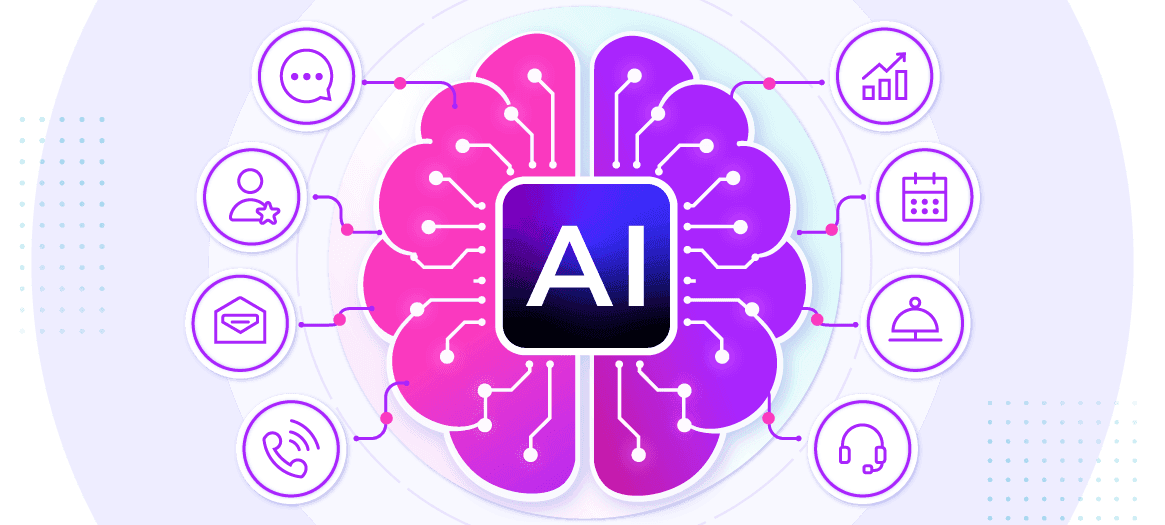
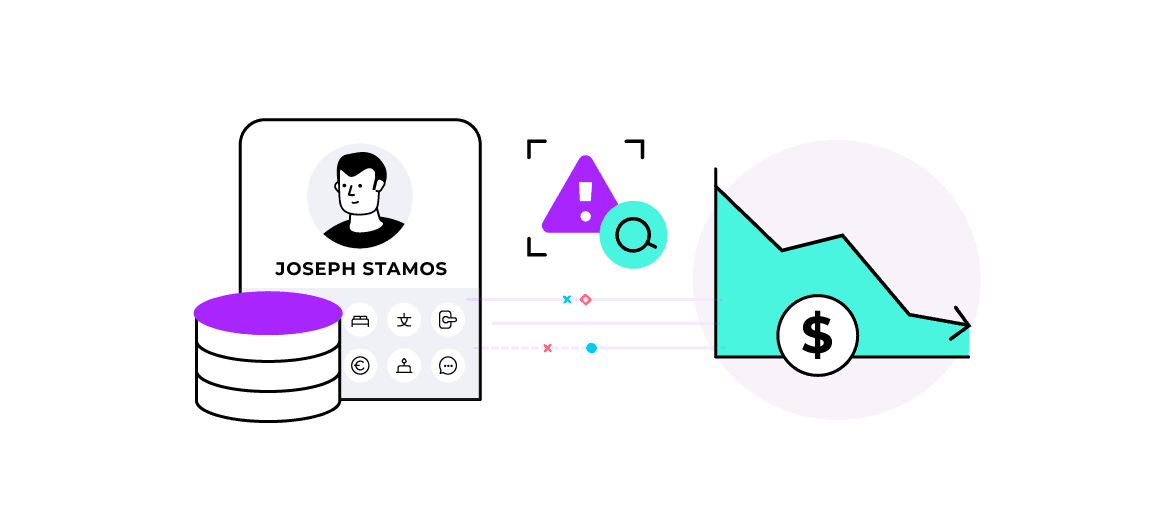
When that logic exists, one well-built base can handle website queries, reinforce WhatsApp and messaging support, assist telephone interactions, help the team with suggested responses, maintain consistency across automated communications and surface which points generate the most friction or recurring questions.
How to move forward with clarity: a realistic roadmap
There is no need to plan a large transformation from day one. The most sensible approach is usually to progress step by step, with focus and a logic of progressive implementation.
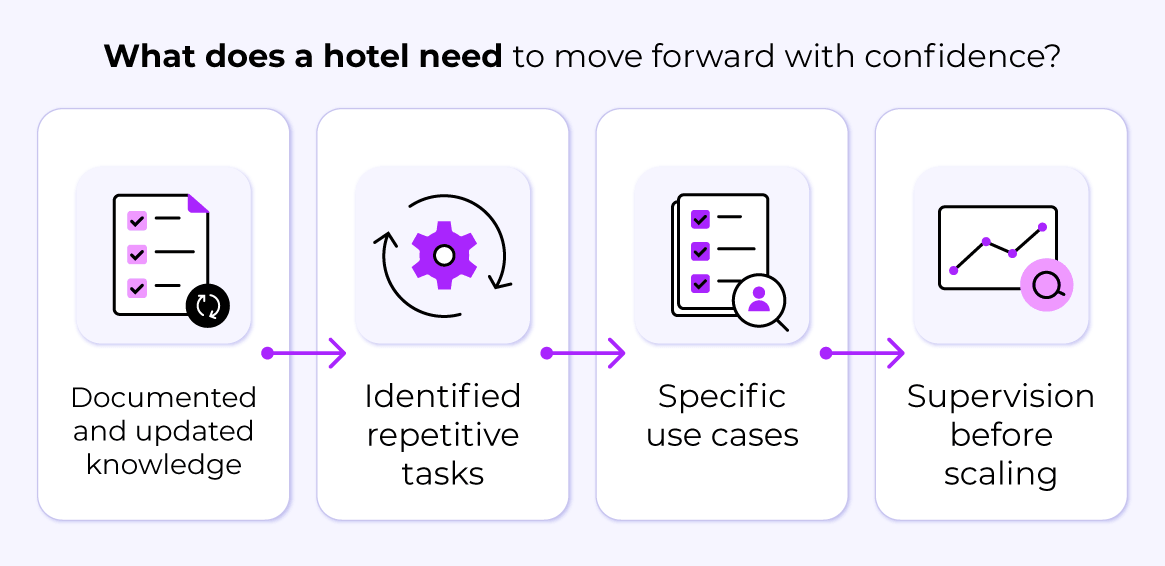
- The first step is to organise the hotel’s or chain’s knowledge, before thinking about any tool.
- The second is to identify which tasks, questions or processes repeat most frequently and consume team time without delivering meaningful differentiation.
- The third is to select one or two concrete use cases that address a real need, have sufficient volume and allow results to be measured with some ease.
- The fourth is to define who will review performance, who will update the knowledge base and which situations should escalate to the human team.
- The fifth is to measure what is actually happening: what the solution resolves, how accurately, and what impact it is having on the guest experience or team efficiency.
- The sixth is to scale only when the first use case is running stably and has demonstrably delivered real value.
The hotels that get the best results from AI are not the ones that invest most from the outset. They are the ones that move with focus, measure what happens and build on a solid foundation.
AI and the human touch are not opposites
One of the most common concerns in hospitality is the fear that automation will reduce the warmth and empathy of the service. It is a legitimate concern. In a sector where the guest experience depends so heavily on personal attention and the ability to handle situations with good judgement, any technology that appears to replace that relationship understandably generates hesitation.
But the more useful question is not whether AI can replace the human touch, but how it can help protect and reinforce it. In practice, most AI-based solutions add the most value when they take on repetitive, low-complexity tasks that currently consume team time without delivering any real differentiation. Answering what time breakfast starts, whether the hotel is pet-friendly or how to request a late check-out are interactions guests value for their speed and clarity, not for the warmth of whoever responds.
A sensitive complaint, a special request or a situation requiring judgement and empathy, on the other hand, still calls for direct and qualified human intervention. Good AI implementation is precisely about recognising that difference and not treating every interaction the same way.
When technology helps absorb part of the repetitive workload, the team gains time to focus on the moments that genuinely require human closeness. That does not make the experience less human. It makes it, in fact, more consistent, more agile and more carefully delivered where it truly matters.
If you want to go deeper on this approach
At Hotelinking we have spent years working on the digitalisation of key processes for hotels and chains. Our view on AI does not start from theory, but from a very concrete reality: when a property’s knowledge is well structured and channels work in a connected way, technology can help respond better, reduce repetitive workload and deliver a smoother guest experience.
We have gathered that experience in a free practical guide — available in Spanish and English — with concrete use cases, the most common mistakes and a roadmap for getting started without risk.